The Migratory Birds in Patna Almost Nobody Notices
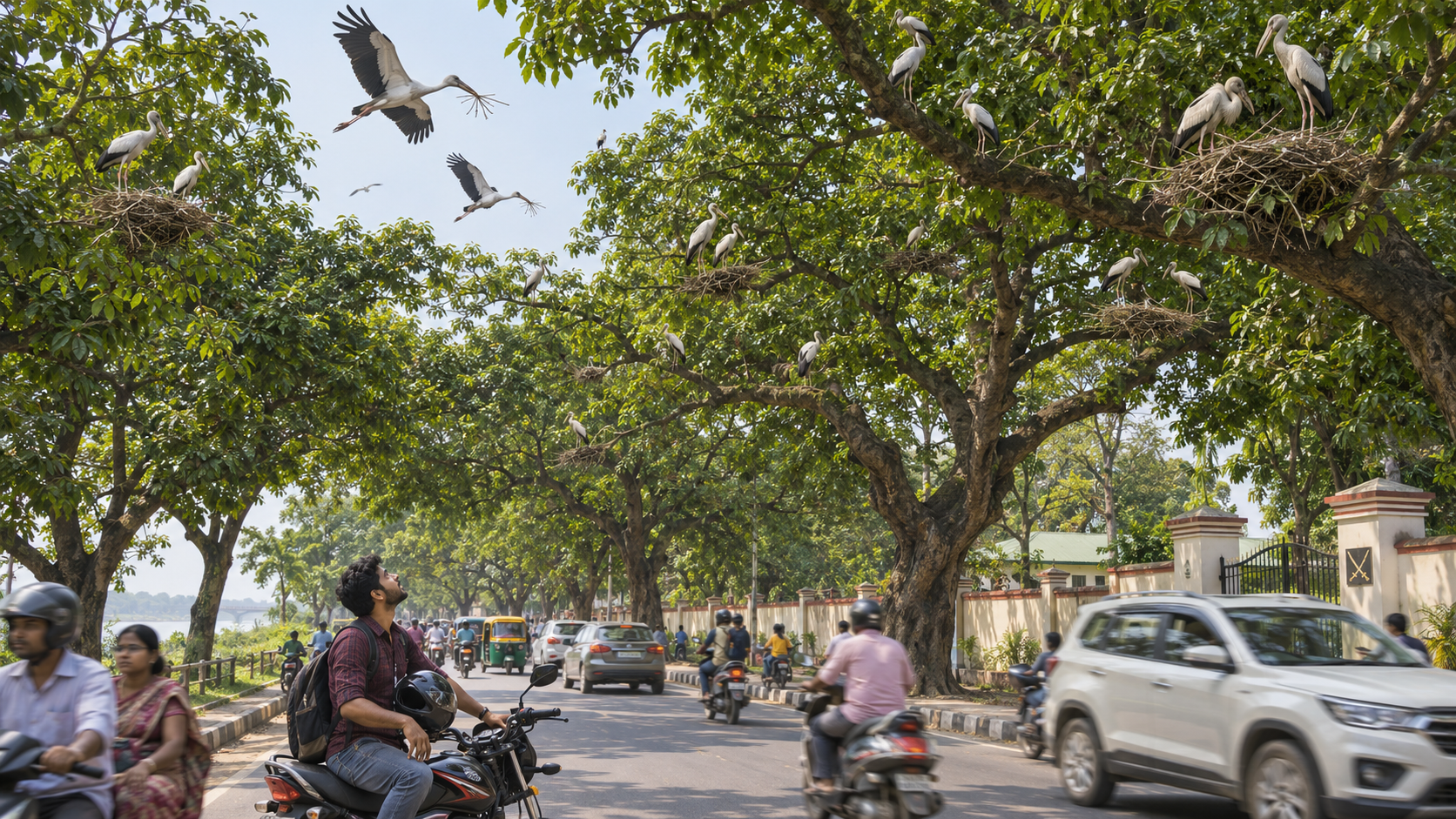
A reminder to look outside your car windows to the roadside trees to see if a foreign friend has come to visit.
A glimpse of two unfamiliar birds near Patna’s Danapur Cantonment leads the writer to one of South Asia’s largest Asian Openbill Stork breeding sites. More than 10,000 storks nest there every year, under the protection of an army that guards the trees, cares for injured birds and prevents poaching. Just 6.5 km away, the city’s Bird Sanctuary Pond in Khajpura has been lost to garbage and construction. The contrast shows how differently the two places treat nature.
I pass by the streets of the city, and I notice two exotic birds on a tree. I instantly knew they didn't belong here. But what are they doing here?
I ask my dad, who was driving the car, to stop so we see them a little better, but he doesn’t. I only get their glimpse for a few seconds. Big, beautiful white body with black feathers and long black beaks.
A few weeks later, I returned to the place with a friend, knowing I can now stop for as long as I want. But would the birds still be there? The chances are slim.
But as we approach the place, I see a similar bird flying in the air and instantly realise they are still there. And just then, I noticed a tree full of birds. They are sitting on them in such large numbers, as if they are the fruits in between the leaves.
And then, we see them on a different tree, then another. And another! And another! And all of a sudden, all the trees around us were filled with these foreign birds. It seems as if they are invisible until you spot one of them, and all of a sudden you see them everywhere you can roll your eyes around.
By this time we had reached the tree I had initially noticed them on and stopped our bike. This is right opposite to the gate of Asia’s Oldest Cantonment, Danapur. And we take a 360-degree view.
We see many birds sitting on the low-lying trees as well, and we notice they are sitting on their nests. Many birds that are flying are carrying small twigs in their beaks.
They are here for a nesting season? What!?
I jump, bend, look over the fences, and stare long enough on their nests to see if I can spot their offspring or eggs. I couldn’t. Ahh, I miss my binoculars!
A series of questions jumped in my head—do they come here every year? How long do they stay? Where do they come from? Where do they go? And out of all the places in the world, why do they assemble in this particular part of the city?
I guess a few reasons in an instant, then and there. This place, firstly, has a lot of trees, and secondly, is situated right at the bank of the Ganga River. And looking at the long beak of the birds, I assume they must feed on aquatic life. The human population also seems to be lesser here due to the army cantonment area, although the traffic on the road is no less, and the ongoing metro construction makes the place no less chaotic.
After all the possible calculations my brain could do, I turn towards Google to find the remaining answers. I couldn't turn towards people in a fairly busy street because I couldn’t find anybody looking at the birds like us. They simply rode away without possibly looking around and noticing they have a flock of beautiful migratory birds right above.
Google does a fair job in silencing my curiosity.
These birds are Asian Openbill Storks. They are partial migratory birds and move between the Indian subcontinent and Southeast Asia. They migrate to North India around June to breed (as we could see) and move towards the southern parts of India or other wetland refuges around November. They have a fairly good population in Malaysia, Thailand, Cambodia, and Singapore.
These birds do not migrate or stay in the entirety of Patna or Danapur; rather, they are specifically found in the Danapur Army Cantonment Area only. Within the area of just 14 square kilometers, it serves as one of the largest breeding stations (or heroneries) for these birds in South Asia, hosting over 10,000 storks annually.
We seek permission at the gate to visit the Ganga ghat inside the premises of the cantonment. They allow it.
Inside the campus, we see the birds casually strolling around on the ground. They definitely find the campus their safe space. Inside we see boards specifically asking the visitors and the residents to keep the birds safe, suggesting the army has actively taken an effort to keep the place safe for the visiting birds.
Digging further on the information, I realised Danapur Cantonment is recognised as an Important Bird Area (IBA) and Key Biodiversity Area (KBA). The army has successfully turned the cantonment area into a micro-ecological zone. Along with these storks, they also have cormorants, egrets, bulbuls, owls, and raptors, along with the globally threatened lesser kestrel, yellow-footed green pigeon, and the black-crowned night heron. This means I need to visit here more often with my binoculars.
The army personnel have specifically worked towards protecting the birds and the trees. I missed mentioning, but the trees here seem to be quite old, and that’s why preserving the historical gems is also quite a challenge, which the personnel here happily work towards with the help of the local conservation groups, such as the Society for Conservation of Flora and Fauna, Patna.
Coming back to the birds, the army also cares for the injured birds and actively prevents poaching, hunting, and other human disturbances. And maybe their efforts have contributed towards an overall increase in the population of these birds, which at one point in time, around 25 years back, was noticed to be declining.
We should definitely learn from the army and provide a similar safe space for birds and animals in the entire city as well. Patna has a Bird Sanctuary Pond in Khajpura; nobody knows about it. Even I didn’t. I once randomly spotted it on Google Maps and decided to pay it a visit. Going there, I saw an extremely poorly maintained pond between housing complexes with garbage thrown all around the water. I spot no birds.
I assume birds did come here back in the day, before houses began occupying this space. When the pond was left unbothered, it was exactly how it should be in its natural habitat. Not only did the citizens and the government poorly maintain the pond, but I also see a building construction taking place on the very site of the pond. Ponds are the natural sponges of the land and are vital for the ecological balance and groundwater replenishment. And, as of today, Patna's Bird Sanctuary Pond has been eradicated completely, leaving no trace of the pond or the birds.
The distance between Khajpura and Danapur Cantonment is approximately 6.5 kilometers. But the gap in the approach, how they look at the trees and the birds, is far wider than what the road stretches.
Latest stories
- Ayushmann Khurrana and Sharvari wrap Yeh Prem Mol Liya at Mumbai’s Banganga
- The Migratory Birds in Patna Almost Nobody Notices
- Bengaluru: Ashwath Bhatt to stage ‘Ek Mulaqat Manto Se’ on November 21
- KASHISH queer film festival makes its Bengaluru debut at NGMA
- Steel Falcon to play Monsters of Rock tribute at Bengaluru’s Cahoots
- GBA says it reclaimed 12.5 acres along Bengaluru stormwater drains
- Delhi PUC rules: newer BS-VI vehicles can get three-year certificates
- Mumbai Earthshot Awards: Princess of Wales wears Mahima Mahajan Anarkali
- Bengaluru to host DIDAC India 2026 on AI and skills from November 25
- Bengaluru’s Puneeth M prepares for 2027 ITF junior tennis events
- Bengaluru: Blinkit delivers GTA VI download-code boxes
- Long Short Stories at Latitude 28 in Delhi
- Delhi names 101 members to five language academy councils
- Ulsoor’s Someshwara temple hosts heritage walks and Brahmi workshops
- Bihar beat Delhi by two wickets despite Dhull’s 125 in Indore
- Baiyappanahalli NGEF shed to house technology museum
- Mumbai: Prince William’s lunch menu included vada pav, Parsi kheema
- Nerul’s Ramlila Ground to host three-day Igas Mahotsav from November 20
- CAQM lifts GRAP Stage III in Delhi-NCR as Delhi AQI reaches 204
- Simone Ashley wears Kanjeevaram lehenga at Mumbai Earthshot Prize
Cities
- Delhi news
- Gurgaon news
- Noida news
- Greater Noida news
- Ghaziabad news
- Faridabad news
- Delhi NCR news
- Bengaluru news
- Mumbai news
- Navi Mumbai news
- Thane news
Sections
- Top Stories
- Latest
- Politics
- Governance
- Civic Issues
- Transport and Traffic
- Metro
- Roads and Infrastructure
- Weather and Air Quality
- Business and Startups
- Real Estate
- Education
- Health
- Environment
- Courts and Policy
- Safety
- Arts and Culture
- Events
- Things To Do
- Food and Drink
- New Openings
- Shopping
- Nightlife
- Neighbourhoods
- People
- Technology
- Sports
GTK covers the news, people, culture, neighbourhoods, civic life and food shaping India’s cities. Better Starts With Us.