Bengaluru Between the Noise
The noise that fills the city, the quiet underneath, and the sonic city that comes into focus
Beyond Bengaluru’s honking traffic and construction noise lies a city of birdsong, pressure-cooker whistles and quiet neighbourhood lanes. Through residents’ memories and everyday encounters, this piece explores how these overlooked sounds shape our experience of place and belonging—and what listening more closely can reveal about the city, its ecology and the lives unfolding around us.
**Rethinking Sound**
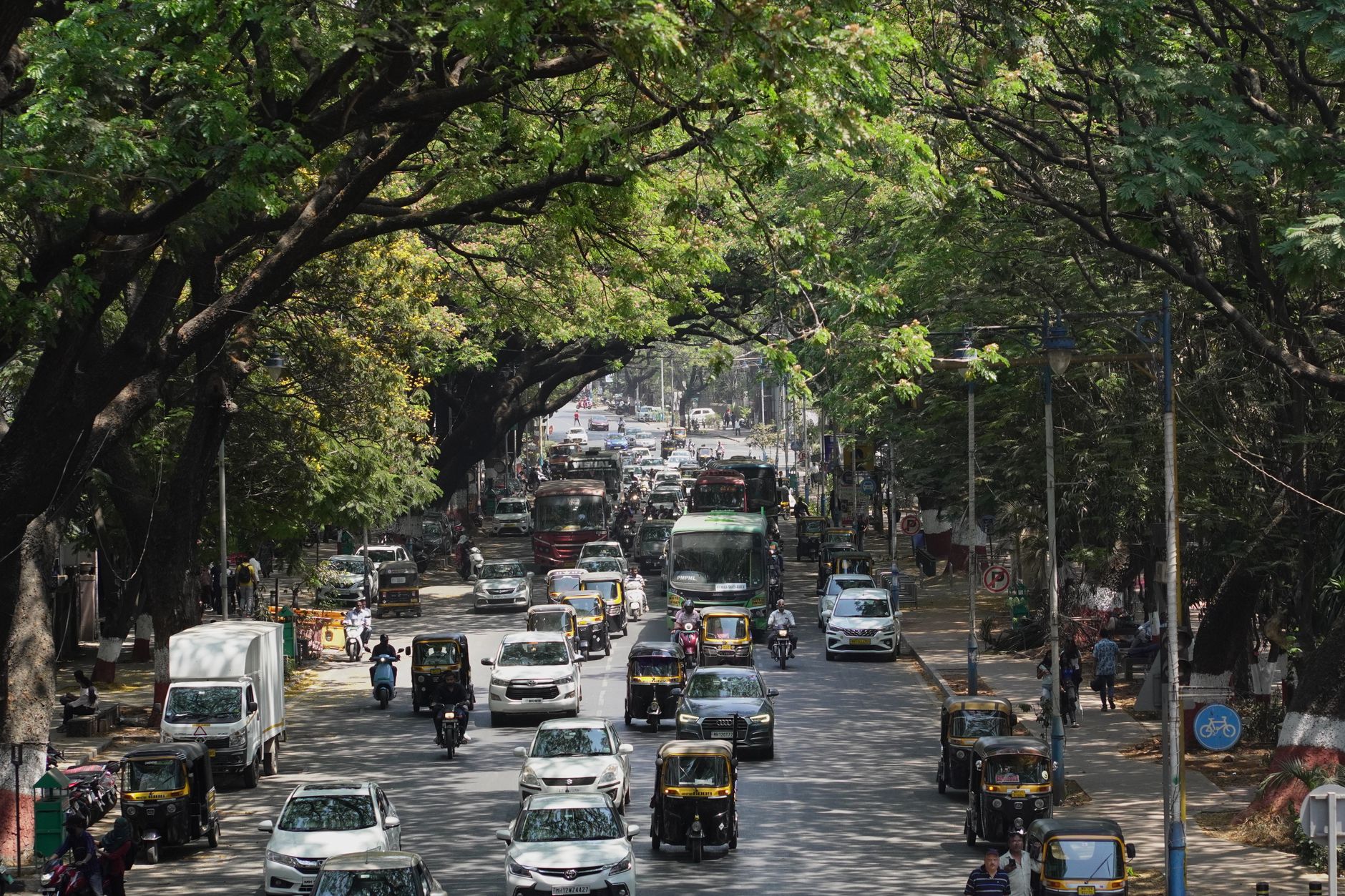
A Bengaluru crowd buzzes, vehicles honk incessantly and intrusively, and at seven in the morning, the traffic is already jammed. Residents living next to the main road wake up to the scraping of a bulldozer tearing down a worn-out house. The wail of an ambulance rattles commuters; yet amidst the chorus of honking and amplified calls of auto-drivers, it momentarily drowns. When the signal turns green, for just a moment, the honking stops. For the first time, the passenger in the auto can hear her own humming.
A city is a map of its sounds. Yet, in an urban environment, sound assumes categories. Noise, rather than sound, demands attention. Noise is regulated to address noise pollution. According to the Karnataka State Pollution Control Board, the permissible noise levels in Bengaluru are 50 dB(A) during the day and 40 dB(A) at night in silence zones, 55 dB(A) during the day and 45 dB(A) at night in residential zones, 65 dB(A) and 55 dB(A) in commercial areas and 75 dB(A) during the day and 70 dB(A) at night in industrial areas. While noise pollution requires urgent attention, what could we discover about Bengaluru if we moved beyond regulation and simply approached the city’s sounds with curiosity?
**A Different Sonic Logic**
A dominant sonic order is easily discernible in Bengaluru. The arrhythmic honking of traffic, clamor of construction, and the buzz of the crowd dominate the city’s soundscape on an average day. These ‘dominant’ sounds become an expected part of Bengaluru’s soundscape, forming the aural backdrop against which life in the city unfolds. The sounds that are most perceptually prominent receive the greatest administrative attention. They are measured and regulated, even if this engagement is intended to control them. In the process, administrative engagement also strengthens their perception as defining sounds and influences how they are recognized in the city's soundscape. Even a soft thud of construction may be considered a defining urban sound, even if it is not acoustically dominant at every point in time, but because its consistent presence and institutional dominance make it an expected feature of life in Bengaluru.
In their dominance, in character, context, administrative recognition, source, and volume, these sounds begin to inform Bengaluru’s sonic identity. In turn, they have the paradoxical effect of ‘muting’ - administratively, socially and culturally - other, non-dominant sounds, which may be perceived, and yet not be engaged with. For example, the trilling of crickets might at times be louder than the hum of traffic and yet not be considered a defining sound. Non-dominant sounds are usually not recorded or mapped, and therefore do not inform the city’s sonic identity. They do not form the backdrop against which life unfolds, but rather recede into the background. To accurately understand the soundscape of Bengaluru is to also explore what emerges when the dominant sounds go mute.
**Acoustic Differences**
When the dominant sounds fall silent, non-dominant sounds become more perceptible. Sometimes, this acoustic difference is perceptible the moment one changes lanes. Anand Paul, an IT employee who lives in Taverekere, BTM 1st stage, explains, “On the main road, you have to navigate through the chaos of heavy traffic and crowds. But the moment you turn into the 2nd cross, an immediate sense of peace and quiet takes over.” For some residents, the sounds emerging in this quiet are disturbing precisely because they are no longer masked. Henia Pfuzeh, a resident of Bannerghatta, describes the nighttime barking of dogs and the occasional motorbike whizzing past as “unusually loud and disturbing.” Neither of these sounds may be exceptionally loud on their own, but their loudness is amplified by their environment. Anand attributes the quietness in the 2nd cross, Taverekere, to the large buildings around him that prevent the noise of the main road from entering his lane. “The entire street is covered by big buildings, so the sound from the main road does not come inside.” Some residents seek quietness. Recalling her days as an engineering student in Bengaluru, who wanted to escape the city on long drives without spending too much, Sundari remembers discovering Pyramid Valley International, a meditation center on Kanakapura Main Road. “The busy Kanakapura road’s hustle and bustle comes to a halt when you take the left towards Pyramid Valley.” Quietness, then, is spatially produced.
The factors that cause these differences in sound across the city become clearer when residents compare the places where they have lived. A resident of Bengaluru, who has lived across Vasanthnagar, SG Palya, and Hulimavu states, “Compared to S.G. Palya and Vasanthanagar, Hulimavu is less noisy. Though a Bullet bike at night and dogs barking are loud and disturbing, I can also hear the birds chirping in the morning. That is a beautiful sound.” They attribute the quietness of Hulimavu to the trees, which allow birds to nest.
Intimate knowledge of a city requires intimate engagement with it. Former resident of Bengaluru, Harsimar Kaur, fondly remembers the city through a sonic memory of quiet. As she moved across the city, she sought different kinds of ‘quiet’. Describing a park near Whitefield where she would go for runs, she notes that despite being frequented by people, dogs, and schoolchildren, it offered her a sense of quiet. During her stay at Kundal Halli Gate in Pavani Visista residential society, she describes her balcony, which overlooked a cluster of eucalyptus trees, as her “refuge of silence.” Though when she visited the place last year, she found the trees had been cut. Her memory of the Gurudwara by Ulsoor Lake is particularly poignant. “When I missed home or wanted to spend time with myself, I used to go there. It is usually very quiet.” Harsimar ends by recalling how she misses the city. In Harsimar’s sonic memory of Bengaluru, quietness becomes an emotional anchor and the thread that connects sound and belonging.
**Soundscape as Knowledge**
Bengaluru does not possess a singular acoustic character or sonic identity. To know a city intimately is to know it through its multifarious local sounds. The ones that emerge from the lives of its residents, the city’s ecology, and the encounters between humans and creatures as they inhabit the city and move through it. It is to notice domestic sounds spilling into the public space of the streets, like the whistle of a neighbor’s pressure cooker. It is to listen to the scrape of child’s roller skates against the gravel of a poorly laid road; the distant jingle of the candyman’s bell; the crunch of dry leaves beneath footsteps; the sharp screech of a wild myna at six in the morning; the sputter of a bike engine coming to life; the chorus of crickets, frogs, mynas, crows; the hissing of the wind; the faint clatter of someone stepping on a loose stone in a manhole. Bengaluru's less perceptible sounds reveal what often goes unheard: an audible geography of everyday life in the city.
Latest stories
- The Blondie House opens in Versova with coffee, matcha and all-day dining
- Delhi’s last red DTC bus withdrawn for scrapping after 15 years
- GMDA hires consultant to link recycled-water pipelines in Gurugram
- Railway Board sanctions trains for Bengaluru Pink Line’s elevated section
- Khalin Joshi takes six-shot lead at Bengaluru Open halfway stage
- MCG gives 24 hours to clear debris from Gurugram public spaces
- Mumbai: S. J. Poddar Academy Grade 6 students curate Zoographia
- Marsh crocodile rescued from 8-foot electricity duct at Aarey Metro complex
- Western Railway says Mumbai division collected 5.2 tonnes in cleanliness drive
- Over 1,000 students exhibit work at Bengaluru children’s biennale
- Delhi to set up 110 collection centres for old and damaged idols
- Mumbai: Nani says The Paradise makers expected an A certificate
- Niranjan Hiranandani shows six-storey Malabar Hill home Kanta
- Mumbai chocolatier makes 75kg chocolate Ganesha idol for Pune
- Heavy vehicles barred on Varthur-Gunjur SH-35 during peak hours
- CSMT inspection: PAC seeks wider north-side entry for evening rush
- Bengaluru Airport T2 hosts ten-day Odia food festival
- Delhi sets up 78 artificial ponds for Ganpati visarjan
- Mahapanchayat backs Gurgaon road-collision accused; biker calls it an attempt to shift the narrative
- Bengaluru Cantonment station redevelopment expected by December 2026
Cities
- Delhi news
- Gurgaon news
- Noida news
- Greater Noida news
- Ghaziabad news
- Faridabad news
- Delhi NCR news
- Bengaluru news
- Mumbai news
- Navi Mumbai news
- Thane news
Sections
- Top Stories
- Latest
- Politics
- Governance
- Civic Issues
- Transport and Traffic
- Metro
- Roads and Infrastructure
- Weather and Air Quality
- Business and Startups
- Real Estate
- Education
- Health
- Environment
- Courts and Policy
- Safety
- Arts and Culture
- Events
- Things To Do
- Food and Drink
- New Openings
- Shopping
- Nightlife
- Neighbourhoods
- People
- Technology
- Sports
GTK covers the news, people, culture, neighbourhoods, civic life and food shaping India’s cities. Better Starts With Us.