Bengaluru's Most Neglected Road Is the One You Walk On
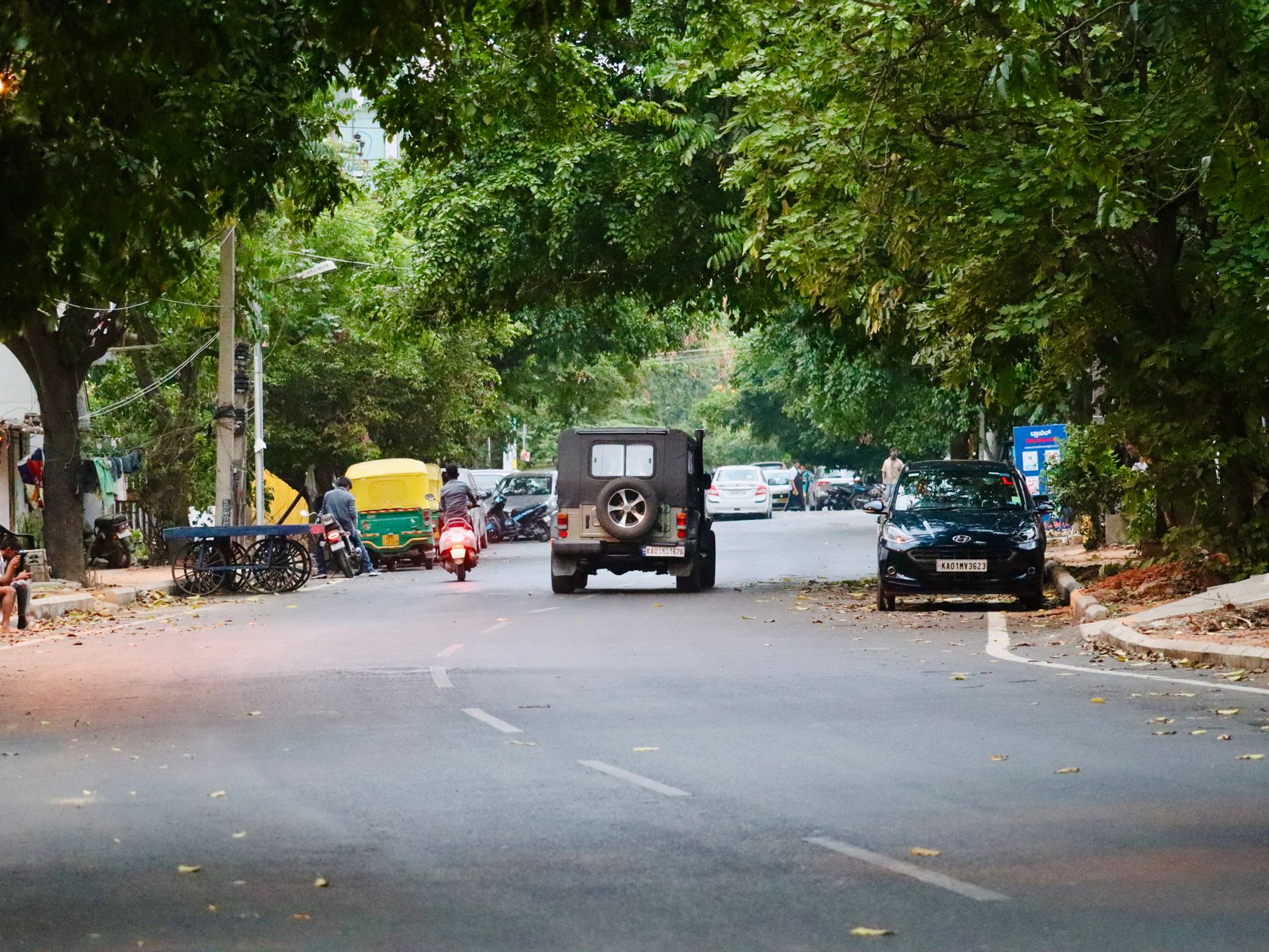
Bengaluru knows how to build streets that work for pedestrians and cyclists. It has even proved it. So why does simply crossing the road still feel like a negotiation with traffic?
Bengaluru’s broken footpaths, unsafe crossings and disappearing cycle lanes reveal a city that continues to put pedestrians and cyclists last. Despite successful projects such as TenderSURE showing what safer streets can look like, progress remains limited—leaving walking and cycling across much of the city unnecessarily difficult and dangerous.
On most days, once mine is done, I walk from Richmond Road toward St Mark's Road. It's not a long walk. It shouldn't be a complicated one either. But before I get there, I have to get through Richmond Circle: a signal, a zebra crossing worn down to a rumour of white paint, and a very short window in which the city seems to remember that a pedestrian exists at all. The light turns, I start walking, and by the time I'm halfway across, traffic from the other direction has already decided my time is up. I finish the crossing at a half-jog, which is not dignified and not really a crossing so much as a negotiated surrender.
Mark Twain once said the reports of his death had been greatly exaggerated. I'd like to report that the reports of a Bengaluru pedestrian's death are not exaggerated nearly enough; the city just doesn't advertise how close it runs the maths every single day.
But this isn't really a story about Richmond Circle, or about my commute. Richmond Circle is just the one intersection I happen to know intimately, the way you know a pothole outside your own house better than any other pothole in the city. The same scene, infrastructure that exists on paper but not in practice, repeats itself at Chinnaswamy Stadium; at MG Road, near Shivajinagar; outside a dozen metro stations; and on almost any arterial road you can name. This is a story about all of Bengaluru's roads and about why walking and cycling on them keeps being treated as an inconvenience the city will get around to eventually.
Start with the numbers, because they're worse than the mood suggests. Bengaluru recorded 768 pedestrian deaths in road crashes over three years through 2024, with pedestrians accounting for roughly a third of the city's total road fatalities, among the highest tolls of any Indian city. Cyclists fare no better on infrastructure, if not always on the fatality count: the city has somewhere between 10 and 15 km of genuinely exclusive, continuous cycle lanes, against a demand that cycling advocates have pegged at 2,000 km. A city mobility plan once promised 50 km of dedicated cycling lanes by 2022. It didn't happen. Meanwhile, over 80 lakh vehicles compete for the same road space every day.
Police records tend to blame pedestrians for crossing "carelessly," away from designated crossings. That framing assumes the designated crossing was a safe option to begin with. At Richmond Circle, at Chinnaswamy, it often isn't, not because people are reckless, but because the signal timing and the traffic behaviour around it were never built to actually protect a person on foot. A large share of Bengaluru's road deaths involve pedestrians, motorcyclists and cyclists: the very users a functioning footpath or cycle lane would have kept out of the traffic stream in the first place.
Bengaluru's streets are asked to do an enormous amount: carry cars, buses, two-wheelers, parking, drainage, utilities, trees, and vendors, all inside a right-of-way that was rarely designed with all of that in mind. Space is genuinely limited. But limited space doesn't explain why, when the competition for that space happens, the pedestrian and the cyclist so consistently lose. Consider what actually happens to a footpath once it's built. It gets used for motorcycle parking because there's nowhere else to park and enforcement against footpath parking is inconsistent. It gets used by street vendors because the same footpath is also their only viable place to earn a living, and the city has offered no real alternative. It gets narrowed by construction, utility boxes, or a shop's informal extension into public space, often for months, with no clear deadline or accountability. A cycle lane, where one exists at all, tends to fare even worse: painted onto a footpath nobody told pedestrians about or quietly repurposed as parking within a year of being inaugurated.
None of this is really a story about selfish motorists or vendors "encroaching". It's a story about a city that has never treated the footpath, or the cycle lane, as infrastructure worth protecting the way it protects a traffic lane. When a road develops a pothole, there's a process, however slow, to fix it. When a footpath disappears under parked vehicles for years, there often isn't one at all.
The frustrating part is that Bengaluru has actually proven it can do better. Starting in 2012, the Jana Urban Space Foundation piloted a redesign model called TenderSURE across roughly ten kilometres of central Bengaluru, rebuilding a handful of Central Business District roads with continuous footpaths, underground utility ducts, and a genuine hierarchy of space for pedestrians, cyclists and vehicles. St Mark's Road, a few hundred metres from Richmond Circle, was one of the roads taken up in that very first phase. More than a decade later, TenderSURE has covered less than 2% of the city's roughly 13,000-km road network. A 2025 assessment found the completed stretches did measurably improve walkability, safety, and flood resilience, which tells you the constraint was never engineering knowledge. Bengaluru knows how to build a street that treats a person on foot or on a cycle as a legitimate user. It has simply chosen, at scale, not to.
Even where it tried, the follow-through has been shaky. Completed TenderSURE footpaths have been damaged by private construction, diluted in design to cut costs, and reclaimed by two-wheelers avoiding traffic. Good design on paper still runs into weak enforcement once it meets the street. A newly formed civic body and a proposed "Walkable Bengaluru Mission" are the latest attempts to scale the model city-wide, proposals that, for now, remain proposals.
It's tempting to blame a single villain: careless motorists, apathetic vendors, or an underfunded civic body. The more honest answer is that it's several failures stacked on top of each other: genuine space constraints, fragmented responsibility between agencies, weak enforcement, and, underneath all of it, a set of priorities where the person walking or cycling has simply never been first in line. Somewhere in that stack is a fairly simple, fairly Bengaluru truth: in this city, the shortest distance between two points is rarely a straight line; it's whatever gap in traffic you can find.
That's the real question underneath the worn paint at Richmond Circle and at every intersection like it: not why one crossing is badly designed, but what it means that a city can spend over a decade proving a pedestrian-first model works, on roads a few hundred metres from where I cross every evening, and still not scale it. A city's footpaths and cycle lanes are a fairly accurate record of who that city was actually built for. In Bengaluru's case, getting from one side of the road to the other, on foot, or on two wheels that aren't motorised, is still, more often than it should be, a negotiation with traffic the city never quite agreed to referee.
Latest stories
- The Blondie House opens in Versova with coffee, matcha and all-day dining
- Delhi’s last red DTC bus withdrawn for scrapping after 15 years
- GMDA hires consultant to link recycled-water pipelines in Gurugram
- Railway Board sanctions trains for Bengaluru Pink Line’s elevated section
- Khalin Joshi takes six-shot lead at Bengaluru Open halfway stage
- MCG gives 24 hours to clear debris from Gurugram public spaces
- Mumbai: S. J. Poddar Academy Grade 6 students curate Zoographia
- Marsh crocodile rescued from 8-foot electricity duct at Aarey Metro complex
- Western Railway says Mumbai division collected 5.2 tonnes in cleanliness drive
- Over 1,000 students exhibit work at Bengaluru children’s biennale
- Delhi to set up 110 collection centres for old and damaged idols
- Mumbai: Nani says The Paradise makers expected an A certificate
- Niranjan Hiranandani shows six-storey Malabar Hill home Kanta
- Mumbai chocolatier makes 75kg chocolate Ganesha idol for Pune
- Heavy vehicles barred on Varthur-Gunjur SH-35 during peak hours
- CSMT inspection: PAC seeks wider north-side entry for evening rush
- Bengaluru Airport T2 hosts ten-day Odia food festival
- Delhi sets up 78 artificial ponds for Ganpati visarjan
- Mahapanchayat backs Gurgaon road-collision accused; biker calls it an attempt to shift the narrative
- Bengaluru Cantonment station redevelopment expected by December 2026
Cities
- Delhi news
- Gurgaon news
- Noida news
- Greater Noida news
- Ghaziabad news
- Faridabad news
- Delhi NCR news
- Bengaluru news
- Mumbai news
- Navi Mumbai news
- Thane news
Sections
- Top Stories
- Latest
- Politics
- Governance
- Civic Issues
- Transport and Traffic
- Metro
- Roads and Infrastructure
- Weather and Air Quality
- Business and Startups
- Real Estate
- Education
- Health
- Environment
- Courts and Policy
- Safety
- Arts and Culture
- Events
- Things To Do
- Food and Drink
- New Openings
- Shopping
- Nightlife
- Neighbourhoods
- People
- Technology
- Sports
GTK covers the news, people, culture, neighbourhoods, civic life and food shaping India’s cities. Better Starts With Us.