How Jantar Mantar became Delhi’s designated protest stretch
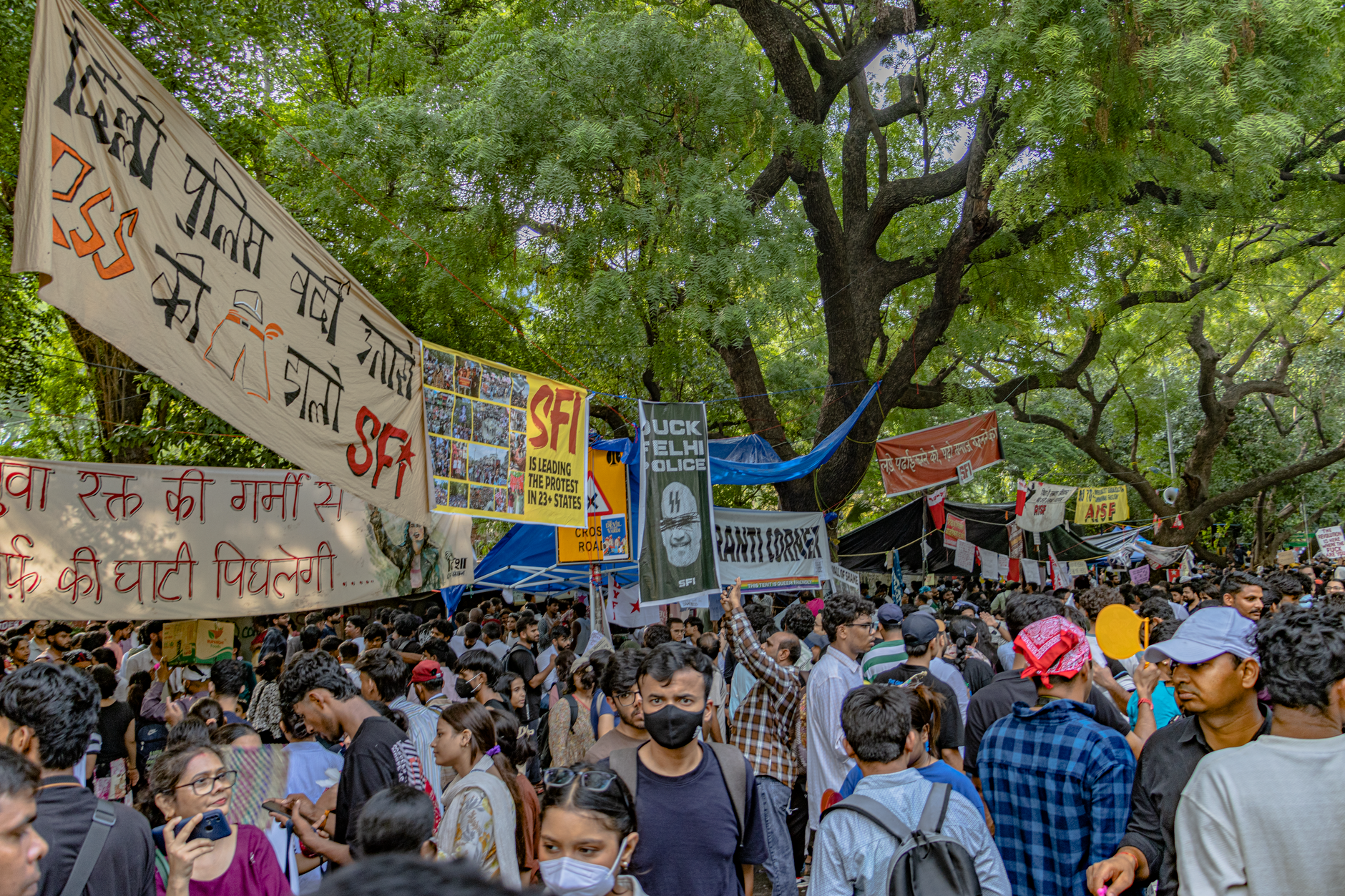
Delhi Police began allowing large demonstrations on Sansad Marg in 1993, shifting protest activity away from the Boat Club lawns near India Gate.
For decades after Independence, the Boat Club lawns were the capital’s principal site for political rallies. Security and administrative pressures from major demonstrations helped move large protests to the stretch beside Jantar Mantar, where access is easier to control while Parliament remains close by.
Jantar Mantar’s role as Delhi’s best-known protest site began with a shift away from the Boat Club lawns, once the capital’s main ground for political rallies.
The lawns near Parliament and India Gate hosted major demonstrations through the early 1990s. In October 1988, lakhs of farmers led by Mahendra Singh Tikait and the Bharatiya Kisan Union stayed in the area for about a week, creating security and administrative strain across central Delhi.
As concerns grew around demonstrations linked to the Janata Morcha-Babri Masjid movement, the administration looked for another location for large gatherings. By 1993, Delhi Police had begun permitting major protests on Sansad Marg near Jantar Mantar, though there was no formal declaration naming it the city’s protest venue.
The dharnas take place on a designated road stretch beside the 18th-century observatory built by Maharaja Jai Singh II of Jaipur, rather than inside the ASI-protected monument. The location keeps demonstrators close to Parliament, government offices and the media, but its smaller footprint and limited entry and exit points make barricading and crowd regulation easier than at the Boat Club lawns.
The site’s future is now part of the debate over an alternative protest venue.
Latest stories
- The Blondie House opens in Versova with coffee, matcha and all-day dining
- Delhi’s last red DTC bus withdrawn for scrapping after 15 years
- GMDA hires consultant to link recycled-water pipelines in Gurugram
- Railway Board sanctions trains for Bengaluru Pink Line’s elevated section
- Khalin Joshi takes six-shot lead at Bengaluru Open halfway stage
- MCG gives 24 hours to clear debris from Gurugram public spaces
- Mumbai: S. J. Poddar Academy Grade 6 students curate Zoographia
- Marsh crocodile rescued from 8-foot electricity duct at Aarey Metro complex
- Western Railway says Mumbai division collected 5.2 tonnes in cleanliness drive
- Over 1,000 students exhibit work at Bengaluru children’s biennale
- Delhi to set up 110 collection centres for old and damaged idols
- Mumbai: Nani says The Paradise makers expected an A certificate
- Niranjan Hiranandani shows six-storey Malabar Hill home Kanta
- Mumbai chocolatier makes 75kg chocolate Ganesha idol for Pune
- Heavy vehicles barred on Varthur-Gunjur SH-35 during peak hours
- CSMT inspection: PAC seeks wider north-side entry for evening rush
- Bengaluru Airport T2 hosts ten-day Odia food festival
- Delhi sets up 78 artificial ponds for Ganpati visarjan
- Mahapanchayat backs Gurgaon road-collision accused; biker calls it an attempt to shift the narrative
- Bengaluru Cantonment station redevelopment expected by December 2026
Cities
- Delhi news
- Gurgaon news
- Noida news
- Greater Noida news
- Ghaziabad news
- Faridabad news
- Delhi NCR news
- Bengaluru news
- Mumbai news
- Navi Mumbai news
- Thane news
Sections
- Top Stories
- Latest
- Politics
- Governance
- Civic Issues
- Transport and Traffic
- Metro
- Roads and Infrastructure
- Weather and Air Quality
- Business and Startups
- Real Estate
- Education
- Health
- Environment
- Courts and Policy
- Safety
- Arts and Culture
- Events
- Things To Do
- Food and Drink
- New Openings
- Shopping
- Nightlife
- Neighbourhoods
- People
- Technology
- Sports
GTK covers the news, people, culture, neighbourhoods, civic life and food shaping India’s cities. Better Starts With Us.