Towards the Maddening Crowd
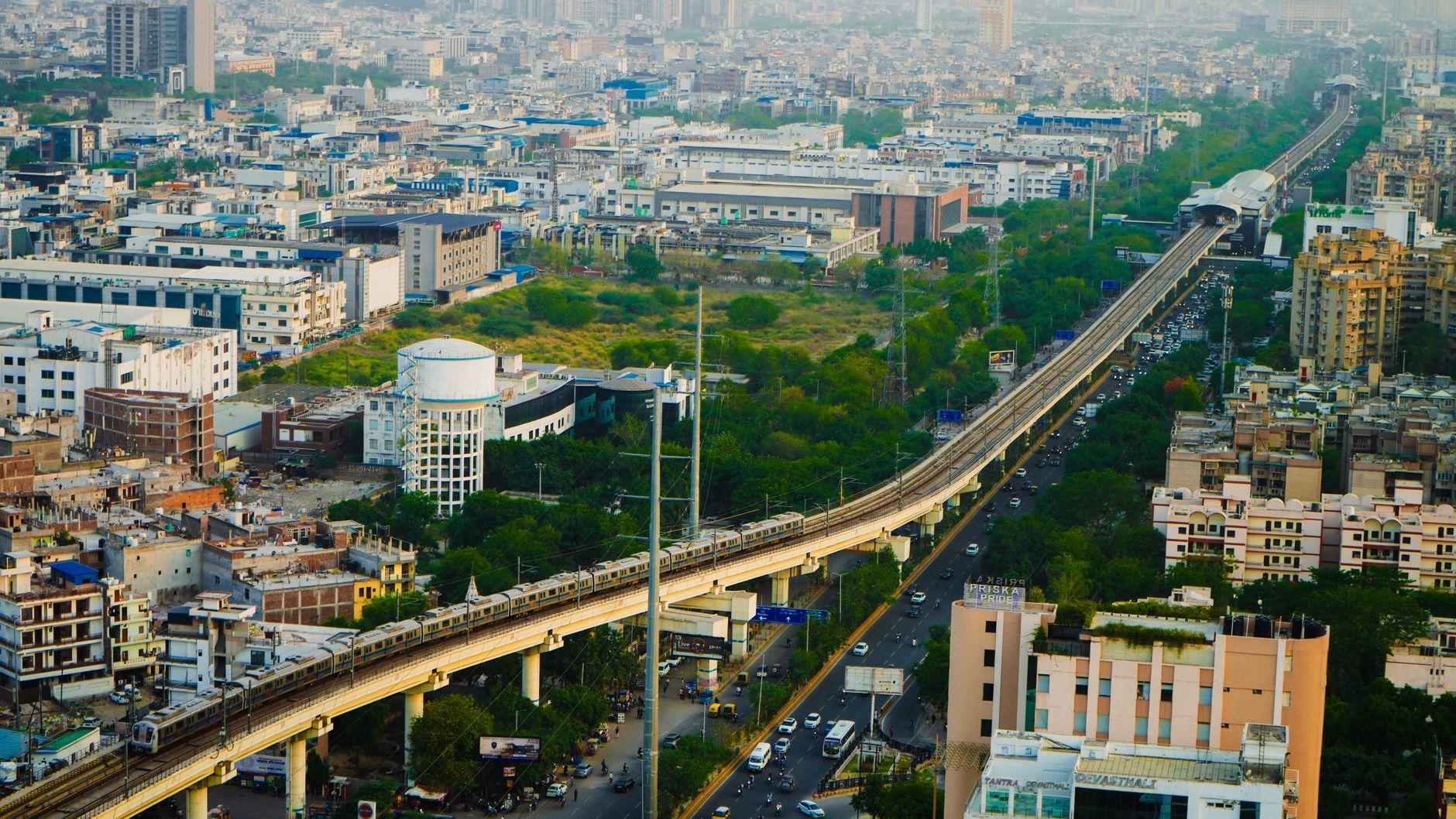
Every morning, thousands cross from Delhi into Gurgaon in pursuit of glass towers, better WiFi and the next promotion. Somewhere between the two cities lies a commute that has become a way of life — equal parts ambition, absurdity and shared suffering.
The daily Delhi-Gurgaon commute is more than traffic, metro crowds and office shuttles. It is a journey between two cities with very different ideas of themselves — Delhi with its history and old rhythms, Gurgaon with its glass towers and corporate ambition. Somewhere between Ghitorni and Arjan Garh, this essay finds the strange humour, rivalry, nostalgia and humanity of moving between the two every day.
There's a particular kind of madness that only makes sense once you've lived it, the daily corporate migration from Delhi into Gurgaon, a pilgrimage that thousands undertake every single morning with the devotion of people who genuinely believe the promised land has better WiFi. Thomas Hardy wrote about crowds and fate and rural folk caught in the churn of a changing world in Far From the Madding Crowd. We, on the other hand, are not fleeing anywhere. We are actively, willingly, driving straight into the madding crowd every morning at 9 AM, coffee in one hand, dignity somewhere in the glovebox, and calling it a commute.
**The Border You Don't Need a Passport For**
Somewhere along NH-48, there's an invisible line that does more psychological damage than any actual international border could. On one side, you have Delhi, government colonies, DDA flats with their peeling paint and their particular brand of old-world stubbornness, roads named after freedom fighters and forgotten kings. On the other side, Gurgaon, or Gurugram if you're feeling official about it, a city that was farmland not too long ago and is now trying very hard to convince you it's Dubai's poorer, more humid cousin. The toll plaza that separates the two isn't just collecting money, it's collecting a small piece of your soul each time, a tiny toll booth confession that says yes, I am doing this again, willingly, for the fourth thousandth time.
And somewhere in that daily crossing, tucked quietly between the noise of one city ending and another beginning, there's a moment that almost nobody talks about, but everybody who's taken the yellow line knows exactly what I mean.
**The Pause Between Two Worlds**
Between Ghitorni and Arjan Garh, there is this odd, unassuming halt on the metro, nothing dramatic, no grand skyline reveal, no cinematic swell of music. But if you're paying even the slightest attention, and most days you're not because you're busy fighting someone for a pole to hold onto, this stretch acts like a signpost. A little pause button placed right there by the universe, or maybe just by whoever designed the DMRC route, who honestly deserves more credit than they get. It's the last exhale before the inhale, the final breath of Delhi's old bones, its historical burials and its slow, unhurried rhythm, right before you get pulled into the corporate realm's relentless hustle. It's genuinely modern day poetry, this stretch, a contrapuntal little dance between rest and relaxation on one side and huddle and hustle on the other, playing out in real time while you're just trying to check if your battery will survive till lunch.
Nobody warns you about this transition. There should be a plaque. Something dramatic. "You are now leaving history behind, please fasten your ambition."
**The Office Shuttle as Group Therapy**
Then there's the shuttle bus, or the Ola Pool, or whichever unholy combination of strangers you've been assigned to for the day. Something strange happens inside these moving metal boxes. You don't know this person's surname, you'll probably never know it, but by Thursday you know their manager is a nightmare, their landlord is worse, and their situationship is somehow both of those things combined. There is a confessional quality to shared commutes that therapists should really be studying, free of charge, four days a week, guaranteed eavesdropping included.
And everyone has their own private map of this journey too, an entirely personal, entirely useless-to-anyone-else system of landmarks. "Past the flyover with the broken escalator." "Near the mall that opened with such fanfare and then just, well, didn't." "The underpass that turns into a small lake every single monsoon, like actual clockwork, like the universe is testing whether you've learned anything from last year." These aren't directions. These are diary entries disguised as traffic updates.
**Cyber Hub and The Great Sibling Rivalry**
Gurgaon likes to think of itself as Delhi's cooler younger sibling, the one who moved out, got a corporate job, started saying "circle back" unironically, and now looks down slightly at the older sibling who still lives in the family house with all its history and its chaos and its charm. Cyber Hub, with its rooftop bars and its very serious lanyards, sells a mirage of a life that's shinier than what most people are actually living. And Delhi, for its part, rolls its eyes and mutters something about how at least it has actual seasons and actual monuments and doesn't flood every time it rains for more than eleven minutes.
There's a low simmering inferiority complex that runs in both directions, honestly. Gurgaon wants Delhi's soul. Delhi wants Gurgaon's infrastructure. Neither will admit it out loud, obviously, that would ruin the bit.
You can spot the sibling rivalry in the smallest, silliest things too. The way a Gurgaon office worker will casually mention their "society amenities" like they're listing off Olympic medals. The way a Delhi native will bring up Purani Dilli food within four minutes of any conversation, unprompted, like a reflex, like it's written into their contract of citizenship. Nobody's wrong, exactly. Everybody's just quietly convinced their half of the map is the better half, and the highway in between is where both delusions politely, exhaustedly, collide every single day.
**The Reverse Commute Nobody Claps For**
But here's the thing that gets quietly ignored in all this, some people travel the other way too. Gurgaon to Delhi, for family lunches, for weddings, for the simple, stubborn need to smell old Delhi's smoke and spice and general delicious chaos again. These reverse travelers rarely get airtime in this story, everyone's too busy complaining about the Delhi to Gurgaon grind to notice the people quietly going home in the opposite direction, chasing something that isn't a paycheck. Maybe it's nostalgia. Maybe it's just better parathas. Both, honestly, are valid enough reasons to sit in traffic for ninety minutes.
There's something almost rebellious about the reverse commuter, if you think about it long enough. Everyone else is racing towards ambition, towards glass and steel and the next promotion, and here's this one person going the other way, towards their mother's kitchen or their childhood gali or a wedding where three aunties will ask them the same question about marriage within the first ten minutes. It's not glamorous. Nobody's writing a LinkedIn post about it. But it might be the sanest decision anyone makes on that entire stretch of highway all day.
**Traffic as a Shared Ritual of Suffering**
By the time you're inching along the highway for the fourth day this week, brake lights stretching out ahead of you like a rosary you never asked to hold, something shifts. The traffic jam stops being an inconvenience and starts feeling like a ritual, a shared, unspoken, deeply Delhi-NCR form of bonding. You've never met the man honking uselessly three cars ahead of you, and yet you understand him completely. You are both suffering the same slow, hot, exhaust-scented purgatory, and somehow that connects you more than any team-building exercise your HR department has ever dreamed up.
Maybe that's the real punchline hiding under all this fluff and fumes. This isn't just a commute, it's become this whole city-region's unofficial group activity, a daily gathering of the maddened, all of us hurtling towards glass towers and free office snacks, occasionally pausing, without even meaning to, somewhere quiet between Ghitorni and Arjan Garh, just long enough to remember that we used to walk slower, once, before all of this.
So the next time you're stuck between two states of being, quite literally, somewhere between Delhi's dusty old poetry and Gurgaon's shiny new prose, take a second to notice that little pause on the yellow line. It's not much. It's just a metro halt, really. But it might just be the most honest ten seconds of your entire commute.
Latest stories
- The Blondie House opens in Versova with coffee, matcha and all-day dining
- Delhi’s last red DTC bus withdrawn for scrapping after 15 years
- GMDA hires consultant to link recycled-water pipelines in Gurugram
- Railway Board sanctions trains for Bengaluru Pink Line’s elevated section
- Khalin Joshi takes six-shot lead at Bengaluru Open halfway stage
- MCG gives 24 hours to clear debris from Gurugram public spaces
- Mumbai: S. J. Poddar Academy Grade 6 students curate Zoographia
- Marsh crocodile rescued from 8-foot electricity duct at Aarey Metro complex
- Western Railway says Mumbai division collected 5.2 tonnes in cleanliness drive
- Over 1,000 students exhibit work at Bengaluru children’s biennale
- Delhi to set up 110 collection centres for old and damaged idols
- Mumbai: Nani says The Paradise makers expected an A certificate
- Niranjan Hiranandani shows six-storey Malabar Hill home Kanta
- Mumbai chocolatier makes 75kg chocolate Ganesha idol for Pune
- Heavy vehicles barred on Varthur-Gunjur SH-35 during peak hours
- CSMT inspection: PAC seeks wider north-side entry for evening rush
- Bengaluru Airport T2 hosts ten-day Odia food festival
- Delhi sets up 78 artificial ponds for Ganpati visarjan
- Mahapanchayat backs Gurgaon road-collision accused; biker calls it an attempt to shift the narrative
- Bengaluru Cantonment station redevelopment expected by December 2026
Cities
- Delhi news
- Gurgaon news
- Noida news
- Greater Noida news
- Ghaziabad news
- Faridabad news
- Delhi NCR news
- Bengaluru news
- Mumbai news
- Navi Mumbai news
- Thane news
Sections
- Top Stories
- Latest
- Politics
- Governance
- Civic Issues
- Transport and Traffic
- Metro
- Roads and Infrastructure
- Weather and Air Quality
- Business and Startups
- Real Estate
- Education
- Health
- Environment
- Courts and Policy
- Safety
- Arts and Culture
- Events
- Things To Do
- Food and Drink
- New Openings
- Shopping
- Nightlife
- Neighbourhoods
- People
- Technology
- Sports
GTK covers the news, people, culture, neighbourhoods, civic life and food shaping India’s cities. Better Starts With Us.