When the Goddess Comes Home: A Bengali’s Guide to the Heart of Durga Pujo
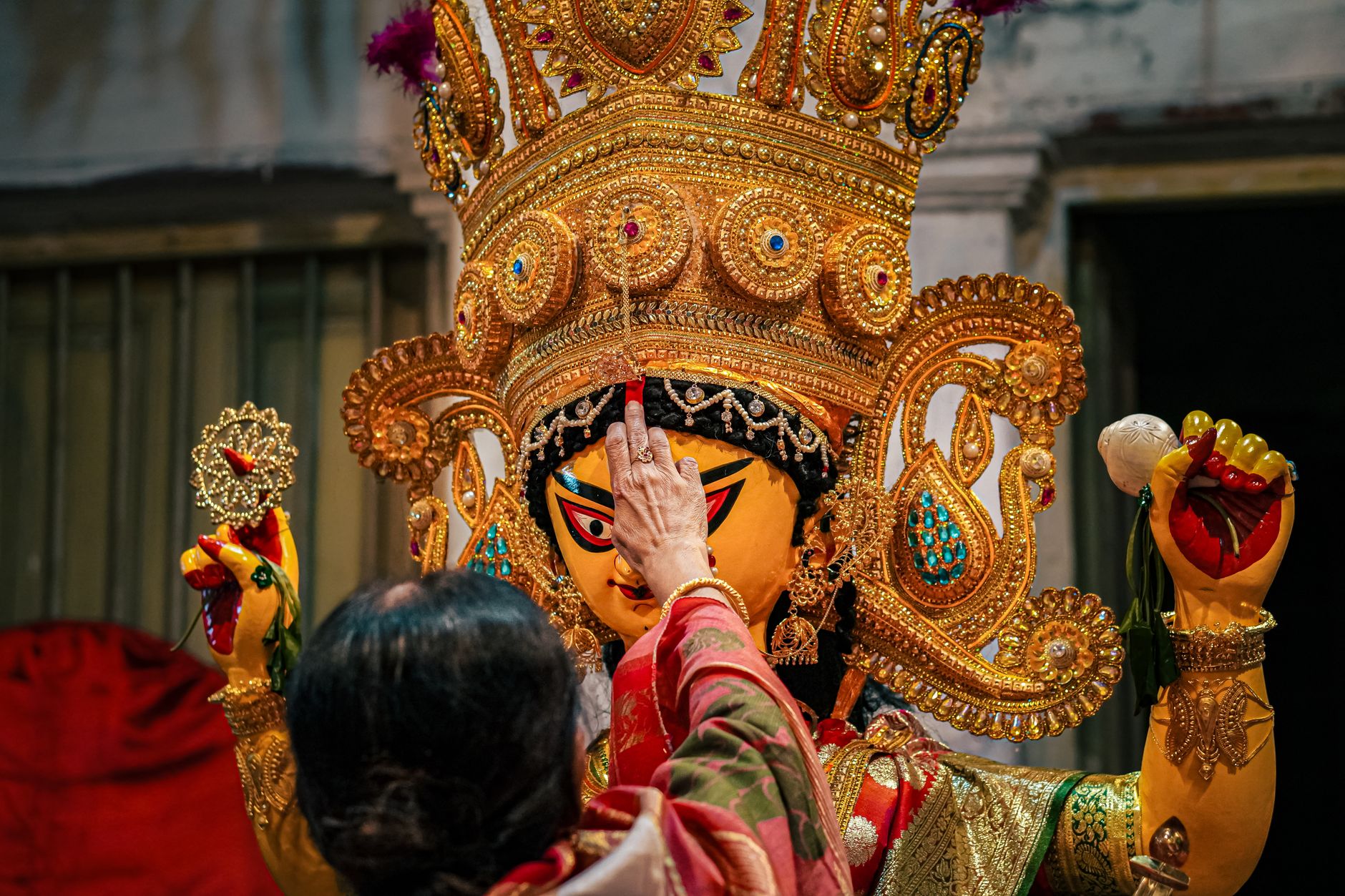
In Kolkata, Durga Pujo begins long before the pandals fill and the dhaak sounds. It lives in months of anticipation, the hands of Kumartuli’s artisans and the tenderness of welcoming a daughter home—followed by a goodbye made bearable by the promise of her return.
From Mahalaya’s familiar dawn broadcast to the bittersweet farewell of Dashami, Durga Pujo shapes Bengal’s emotional calendar. This personal account moves through Kolkata’s idol-making traditions, rituals and celebrations to explore a belonging that extends beyond religious belief. At its heart is Maa Durga’s homecoming as a daughter, bringing families and neighbourhoods together through anticipation, joy and the ache of parting.
**‘Maa Aashche’!**
For a Bengali, Durga Pujo is anything but just another festival. To us, it is the festival. Regardless of how ‘Bengali’ one is, all of us partake in visualizing the entire year with Pujo at the centre. Most of the time, we don’t even realize we’re doing it. For example, when someone asks me when Diwali or a completely unrelated festival falls in a year, I instinctively calculate that on the basis of when Durga Pujo is that year. We plan all our holidays around it, begin our window-shopping well in advance so that when the time finally arrives, we’re fully prepared with all our R&D. Family visits are discussed months in advance and somewhere, almost without our noticing, we begin counting down.
The actual Pujo is celebrated over four key days-Saptami, Ashtami, Navami and Dashami; with Ashtami (the eighth day) traditionally being the most significant while Dashami (the last day) brings an end to the festivities.
With that said, the feeling of Pujo begins much earlier. Mahalaya (the first day) announces that Maa Durga has embarked on her journey to come to us, Shashti (the sixth day) brings the anticipation to a frenzy and by Saptami (the seventh day), we’re already running amok. A curious thing about that anticipation is, it is an unspoken ritual; you must wait and you must endure the longing. It fuels the desire to celebrate to the fullest and to preserve the happiness you’ll feel.
We, Bengalis, often say that we have two mothers: our own Maa and Durga Maa. The phrase ‘Maa aashche’-Mother is coming- has a way of awakening a primal cultural pull that lies asleep within every Bengali. However, Maa is not merely coming to be worshipped; she’s coming home. She’s not coming as a goddess; she’s coming as a daughter.
Perhaps that’s why even while we're celebrating her arrival, we’re also carrying the grief of her departure silently. With tears in our eyes, we smile through the pain and say: Aashche bochhor aabar hobe-next year, she will come to be with us again. This goodbye holds the promise of return; and this promise has held generations of Bengalis together.
**‘What if I’m not religious?”**
You don't have to be.
This is perhaps the hardest thing to explain to someone who has never experienced Durga Pujo in Kolkata or in Bengal, at large. For us, Pujo is deeply spiritual and cultural. In many ways, it doesn’t cater to religiosity in the typical sense.
Kolkata becomes a ginormous carnival. Pujo is about colors, lights, Rabindra Sangeet on every street, dhunuchi’r dhhuo (smoke from the dhunuchi), food, family, fashion and oh-so-much adda. It is about eitaao korbo aar oitaao korbo (I’ll do this and I’ll also do that). It is the one time when neither of us feels guilty about saying, aamaar chaai (I want) to just about anything. Furthermore, Durga Pujo is a celebration of femininity.
Durga is powerful without losing her tenderness; formidable yet indubitably a mother. She is Shakti, the embodiment of strength and energy but she is also just a daughter returning home. And that homecoming, is the touchstone of Pujo.
Pandal-hopping is not the same as idol-worshipping at the pandals; wearing your best clothes and looking like a million bucks is not a religious ritual, dancing internally to the dhaak (a large traditional percussion drum) is not something that is asked of you. You do these because you can’t help yourself.
With that said, let’s delve into the elements that make Pujo, Pujo.
**Durga Protima (idol)**
Before she becomes the goddess we recognise, she begins as clay. Maa ascends to divinity only after rising from the mud.
And this is where Kumartuli comes in.
Across three hundred years, north Kolkata has nurtured a lineage of sculptors. The alleyways dissolve into a world suspended in creation. The idol itself begins with a bamboo framework called kathamo. Layers of straw and clay are built over it, shaped and left to dry before the final painting and decoration.
There is something alchemical about seeing the idols at this stage. Durga is merely an unfinished figurine. If I’m being honest (please don’t come for me!), the structure of the idol-to-be resembles a scarecrow. As a layperson, I cannot fathom how that becomes a goddess who embodies perfection. Perhaps Maa blesses the hands of the artisans herself. I cannot find another explanation.
But the artisans don’t just create her, they also bring into being her four children—Lakshmi, Saraswati, Kartik and Ganesh. Even though they are worshipped individually at different times of the year, Pujo is not about them. They are simply the little children who have accompanied their mother on her journey home.
A rather unusual tradition in the making of the protima is, that soil is collected from outside a sex worker's home which is then mixed with clay collected from the banks of Hooghly. It is called punya maati (blessed soil). There is something deeply empowering in that tradition. A forbidden territory (nishiddho palli) becomes one with the divine. Maa Durga is in all of us irrespective of who we are, what we do and what we believe in.
The traditional decoration of the idol is called daaker shaaj. Today the appearance of the Goddess often reflects the artistic vision and theme of that particular pandal but when you finally see her standing there, she is unmistakably Durga. The most beautiful woman in this world and in every world she exists in.
Welcoming her back to her baaper baari (agamoni)
When every woman comes of age, she starts mentally preparing for the day she would need to leave her baaper baari (paternal-maternal home) for her shoshurbaari (home of the in-laws). I believe every parent knows how terrifying and heartbreaking it is for their daughter to leave the safety of their home to enter unknown, uncharted territory and suddenly call it her new home. But this is the custom; they can’t change it. Hence everytime their daughter announces her return, even if it is only for a couple of days, they leave no stone unturned to celebrate her. In many parts of India, parents tell their daughters that they belong to their husband’s family after marriage but Bengalis reject this custom.
We might be wives, daughters-in-law and mothers but we’re told that we are our parents’ daughters first and we will always be; even when they’re no longer alive. Whenever the married daughter returns home, parents pamper her and her children with unconditional love. That, is exactly how Maa Durga and her children are welcomed.
Mythologically, Maa Durga lives with Lord Shiva on Mount Kailash and returns to her earthly home each year with her children. Her arrival is therefore imagined not simply as the descent of a deity but as the return of a married daughter to her baaper baari-her parents' home. Which is why many of the rituals of Pujo carry the tenderness of welcoming a daughter home.
The bittersweet ache of Bijoya Dashami when the household tearfully bids farewell to Maa Durga as she returns to her husband, is the same ache a parent feels when their daughter packs her bags to return to her in-laws. The empty house left behind after Durga Puja perfectly captures the quiet loneliness of a paternal home when a daughter and her children leave.
**Mahalaya**
If you really want to understand what Pujo means to a Bengali, wake up before dawn on Mahalaya. For generations of Bengalis, Mahalaya itself has been inseparable from the voice of Birendra Krishna Bhadra. At 4:00AM sharp, homes across Bengal wake up to Mohishasurmardini and then, all of a sudden, Pujo has begun.
We wait for the familiar ‘jaago tumi jaago. Jaago Durga jaago dashapraharanadharini’ (please rise, Durga. Please awaken, the wielder of ten weapons). I don’t think it’s possible to even write this without crying. Perhaps the sound of Birendra Krishna Bhadra breaking into tears himself while he was recording it makes it so achingly pure and nostalgic.
The most important part of Mahalaya is Chokkhu Daan when the eyes of the Goddess are painted. It is one of the most auspicious moments of Pujo. Until then, the idol has no eyes but with that final, delicate stroke, Maa is awake. In Kumartuli, the senior artisan undergoes a purification ritual (along with fasting) and paints the eyes at the same time as Mohishasurmardini plays in the background. Maa has three eyes: Trinayana (the central eye of wisdom) along with the left and right eyes.
**The rituals you may not know**
On Shashti, when the face of the Goddess is unveiled amidst the thunder of the dhaak, the rituals start gathering momentum from that moment onwards. Kola Bou Bodhon, the ceremonial bathing and consecration of the banana plant, traditionally with Gangajol (water from Ganga), marks the beginning of Maha Saptami.
One of the most beautiful traditions is Kumari Pujo in which a young, pre-pubescent girl is worshipped as an embodiment of the Goddess. This places the idea of feminine power and divinity quite literally at the centre of the celebration.
The one event we wait for the most is Sandhi Pujo. It occurs during the last 24 minutes of Ashtami tithi and the first 24 minutes of Navami-the transitional period is known as Sandhikhan. A point to note is that it does not correspond to our conventional idea of time which means Sandhi Pujo, can fall at almost any hour depending on the year.
This ritual commemorates the moment when Maa, in her fierce form as Chamunda defeats the demons, Chanda and Munda. It is intense and deeply atmospheric. The lamps (108 earthen lamps), the chanting, the dhaaks, the lotuses (108 too), the yagya, the dhunuchi aaroti-all of it together transcends you into a completely unexpected spiritual realm. It makes you feel like you’re truly one with the goddess.
However, by the time your goosebumps are still fresh, Dashami arrives.
**The goodbye we’re never prepared for**
Sindoor Khela is one of the most recognisable rituals of Dashami. Traditionally, married women apply vermilion to one another as they bless each other for a happy married life. It symbolises the transition Durga would be making from being a daughter to resuming her role as a wife. It looks a bit like Holi but with shidoor. However, the unmarried women aren’t left behind either. When someone puts shidoor on you, it is their way of blessing you towards a prosperous married life in the future.
Immediately after, every single person around you is crying and doing kolakuli (embracing each other, feeding everyone sweets and touching the feet of all the elders). With a heavy heart, we finally start preparing for bishorjon (immersion of the idol into Ganga). But we don’t part with Maa silently; the dhaakis (the dhaak players) incessantly play while a lot of us are performing the dhunuchi naach (dancing with the dhunuchi) on the way. It is absolutely unacceptable for us to part ways with her sadly.
Watching Maa’s idol become one with the Ganga (symbolising her return to heaven) and then returning to an empty house or empty paaras (neighbourhoods) is a pain that is better left unexplained.
Since Durga Pujo is a festival built around both arrival and departure, we spend months waiting for Maa; four days celebrating her and then all of a sudden, she’s left us. She has her own responsibilities to get back to. She might be a mother and daughter to us but we also recognize that she’s still a goddess.
So, we tell ourselves what we always have-aashche bochhor abar hobe.
Latest stories
- The Blondie House opens in Versova with coffee, matcha and all-day dining
- Delhi’s last red DTC bus withdrawn for scrapping after 15 years
- GMDA hires consultant to link recycled-water pipelines in Gurugram
- Railway Board sanctions trains for Bengaluru Pink Line’s elevated section
- Khalin Joshi takes six-shot lead at Bengaluru Open halfway stage
- MCG gives 24 hours to clear debris from Gurugram public spaces
- Mumbai: S. J. Poddar Academy Grade 6 students curate Zoographia
- Marsh crocodile rescued from 8-foot electricity duct at Aarey Metro complex
- Western Railway says Mumbai division collected 5.2 tonnes in cleanliness drive
- Over 1,000 students exhibit work at Bengaluru children’s biennale
- Delhi to set up 110 collection centres for old and damaged idols
- Mumbai: Nani says The Paradise makers expected an A certificate
- Niranjan Hiranandani shows six-storey Malabar Hill home Kanta
- Mumbai chocolatier makes 75kg chocolate Ganesha idol for Pune
- Heavy vehicles barred on Varthur-Gunjur SH-35 during peak hours
- CSMT inspection: PAC seeks wider north-side entry for evening rush
- Bengaluru Airport T2 hosts ten-day Odia food festival
- Delhi sets up 78 artificial ponds for Ganpati visarjan
- Mahapanchayat backs Gurgaon road-collision accused; biker calls it an attempt to shift the narrative
- Bengaluru Cantonment station redevelopment expected by December 2026
Cities
- Delhi news
- Gurgaon news
- Noida news
- Greater Noida news
- Ghaziabad news
- Faridabad news
- Delhi NCR news
- Bengaluru news
- Mumbai news
- Navi Mumbai news
- Thane news
Sections
- Top Stories
- Latest
- Politics
- Governance
- Civic Issues
- Transport and Traffic
- Metro
- Roads and Infrastructure
- Weather and Air Quality
- Business and Startups
- Real Estate
- Education
- Health
- Environment
- Courts and Policy
- Safety
- Arts and Culture
- Events
- Things To Do
- Food and Drink
- New Openings
- Shopping
- Nightlife
- Neighbourhoods
- People
- Technology
- Sports
GTK covers the news, people, culture, neighbourhoods, civic life and food shaping India’s cities. Better Starts With Us.