You Can’t Talk About Patna Without Talking About Her
To know the city is to know the Ganga that has held its story for centuries
Sometimes, you know more about the river in a popular tourist destination than the one that quietly flows in your own city. The Ganga is an inseparable part of Patna, yet much of the life around its ghats remains unexplored by most. From the flora and fauna that survive around its waters to the lives of the people who live in and around the riverbed, there is a story to the river, you know, and the riverbank, you don't.
I stand on the terrace of my eight-storey building. This height is tall enough for a building in Patna to give you the luxury of enjoying a skyline and cityscape view.
I can see the vast stretch of concrete as far as I can roll my eyes, even recognising the last high-rise of the city.
But my city’s story does not begin here; it begins with what lies beyond that building—a massive, five-kilometre-wide expanse of the Ganga riverbed.
If I had to write about my city, I would begin by writing her. She is revered as holy by the people for centuries. It was she who made the city exist long before urban India was a thing, making Patna one of the oldest cities in the country.
We speak of the Ganga of Varanasi, Haridwar and Rishikesh, but I have seen only a few people romanticising the same river in their own city.
I recovered from an illness lately. After a successful surgery, people asked me to visit ‘Banaras’ and take a dip in the holy river in gratitude.
We have the same Ganga here as well, but somehow she is not considered as important. Her cultural significance holds true only during the festival of Chhath.
Why isn’t she valued here as much?
Some of it is perspective; some of it is the nature of the river and the people here.
Unlike Varanasi, the Ganga is spread across a vast terrain of land here. She changes her path frequently, and recent findings have proven she is moving away from the city. A 5-6 kilometre shift is already evident. Seems like she prefers staying away from the hustle and bustle, and her aquatic life seems to prefer her choice, too.
When I was younger, visiting her was a rare event. I would hear from the older people that they had spotted dolphins here back in the day. Growing up, I never had a chance to spot them at the traditional ghats of Patna, like the Gandhi Ghat and its neighbours, and always thought either they had moved away or had never existed at all.
It was only when I discovered her less crowded banks, locally known as diara, I, too, spotted them. And to this day, I feel happy to see they have not moved away yet. Evenings and afternoons by these ghats could be a great time to witness the dolphins breaching Ganga’s surface (especially during winters); while the flock of beautiful migratory birds (I still need to learn their names) flying close over her water steals the early morning show.
But, more than the dolphins and the birds, there’s something else that catches my attention whenever I am here.
The boats.
Not the recreational ones. But the ones that float livelihoods from the other side of the shore.
Any time of the day, you’ll find these boats filled and crowded with local people coming and going. These people come to the city with whatever they have to offer.
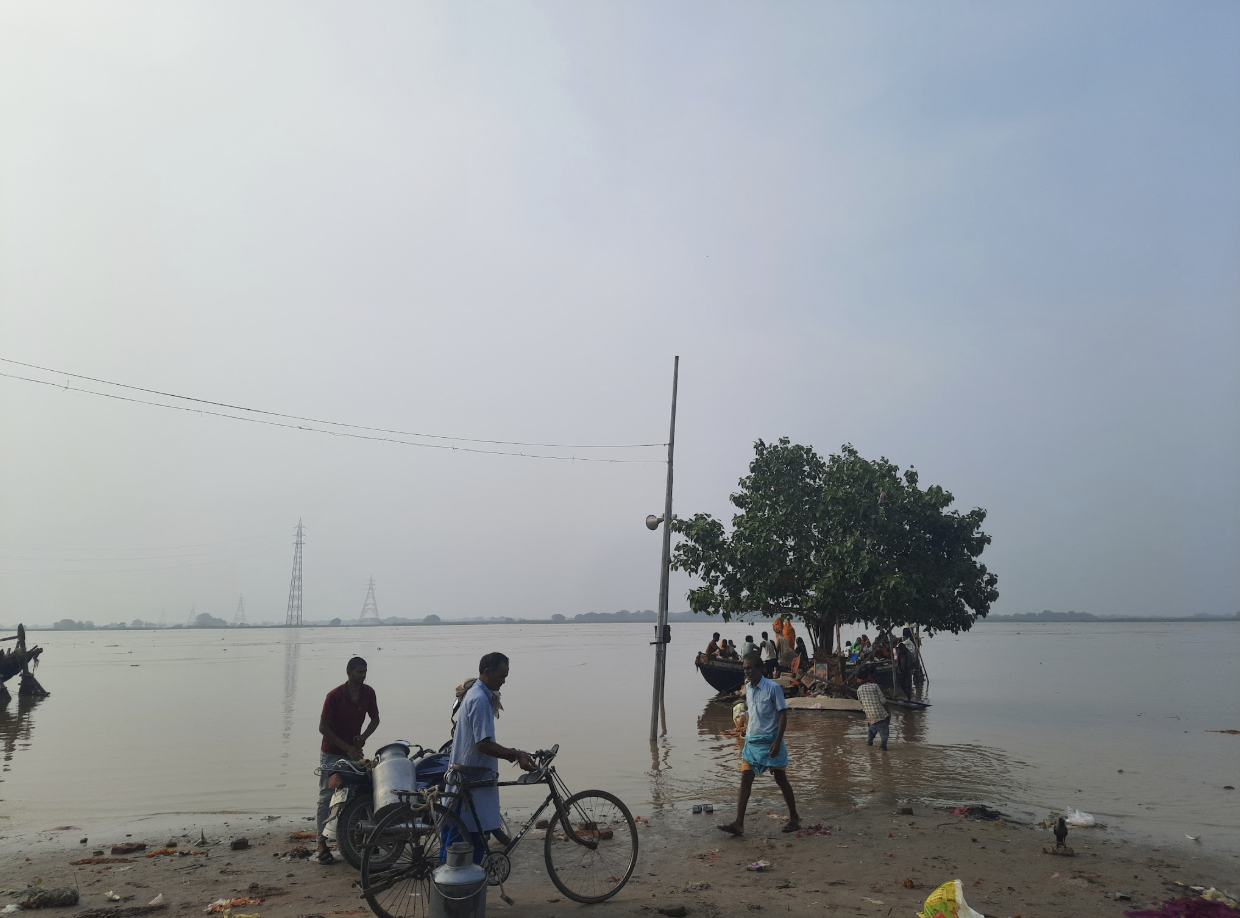
The boats carry a bunch of motorcycles, generally of milkmen with big cans hanging on them, cycles of the vegetable sellers with big baskets of fresh vegetables, and a bunch of women, mostly coming to the city for some work or labour. Yes, all on a single boat.
These people come from the large delta that the river leaves behind while flowing across two major streams in this area. They live in her riverbed, the 5-kilometer terrain I talked about, and use the highly fertile land to earn a difficult livelihood.
I observe the riverbed from the top view whenever I happen to cross the J.P. Setu, the rail-cum-road bridge that connects Digha and Sonpur.
I notice their small houses, the massive land they grow their crops on, a few women working in the fields, and cattle grazing out in the open. I often think of the people living here. What would their lives be like, living in the heart of a riverbed?
When I was younger, a milkman would come to our house from the other side of the river to drop 3 litres of milk off to us every day. Now that I see these milkmen travelling from the boat on their cycles/motorcycles, I realise he was one of them, too.
Little do we realise how much of the city runs on their effort and labour. The river offers us more than her holy water and serene views.
Today, when the river has raised her water above the danger levels, and the ghats are flooded, people still manage to drop themselves to this side. The boat takes a different route, carrying less weight than other times, and more people come empty-handed than before. They have probably lost a major part of their land to water. The boats are fewer in number, too. Many of them are parked on the side, waiting for a safer time to float back.
The milkman taking his cycle to the boat in a flooded Ganga
Today, the human footprints by her riverside have increased rapidly after the inauguration of the J.P. Ganga Path, a.k.a, Patna Marine Drive. It has a decent walking track with sitting areas, making it a new evening recreational spot in the city.
The road also connects AIIMS and PMCH, two major government hospitals of Patna, reducing the travel time from one and a half hours to 20 minutes now. It also connects Patna to its neighbouring towns. A person passing by Patna doesn’t necessarily have to enter the main city to reach the other side, again reducing the travel time by hours.
Just a few ghats away from the Marine Drive, we have an evening Ganga Aarti, following the patterns of the famous Varanasi Ganga Aarti. It is still an underrated activity, away from the crowd’s attraction, because most of them drop directly at the Ganga Path.
Spending an evening by this ghat feels less like a recreational activity and more like entering into the lives of locals living by the river. The children playing sports like cricket and football, smaller kids running around trying to catch each other, uncles sitting in groups in discussion, washerwomen all the way down in the water doing their clothes, young men and some other children in the water, swimming.
I also know how to swim, but never have I ever swum outside of a swimming pool. Swimming in the Ganga comes with a class difference, I see. The so-called lower class lives a richer life.
So, whenever I have an evening free by myself, I take myself to this particular ghat, sit alone, and just observe the life around. I see the boats coming and leaving one after the other, like the planes in an airport. I wish to see the other side as well. But the deep-rooted safety concerns in my head never allow me to take the boat alone with the locals and explore the island in the middle of the riverbed. (Let’s save the tale of safety in this developing city for another time?)
So, I sit alone longer. Watch the river water flowing by, hear the soft, melodious Ganga Aarti from afar, and feel she never belongs as much to me as she does to them.
Maybe that’s why Ganga in Patna is not as prominent as she is in the other religious cities, because here, she belongs more to livelihood and daily survival than she does to ritualistic devotion.
Latest stories
- GMDA hires consultant to link recycled-water pipelines in Gurugram
- Railway Board sanctions trains for Bengaluru Pink Line’s elevated section
- Khalin Joshi takes six-shot lead at Bengaluru Open halfway stage
- MCG gives 24 hours to clear debris from Gurugram public spaces
- Mumbai: S. J. Poddar Academy Grade 6 students curate Zoographia
- Marsh crocodile rescued from 8-foot electricity duct at Aarey Metro complex
- Western Railway says Mumbai division collected 5.2 tonnes in cleanliness drive
- Over 1,000 students exhibit work at Bengaluru children’s biennale
- Delhi to set up 110 collection centres for old and damaged idols
- Mumbai: Nani says The Paradise makers expected an A certificate
- Niranjan Hiranandani shows six-storey Malabar Hill home Kanta
- Mumbai chocolatier makes 75kg chocolate Ganesha idol for Pune
- Heavy vehicles barred on Varthur-Gunjur SH-35 during peak hours
- CSMT inspection: PAC seeks wider north-side entry for evening rush
- Bengaluru Airport T2 hosts ten-day Odia food festival
- Delhi sets up 78 artificial ponds for Ganpati visarjan
- Mahapanchayat backs Gurgaon road-collision accused; biker calls it an attempt to shift the narrative
- Bengaluru Cantonment station redevelopment expected by December 2026
- Railways approves ₹497 crore to double Chouk–Karjat line
- Delhi Metro logs record 82.45 lakh boardings during DTC strike
Cities
- Delhi news
- Gurgaon news
- Noida news
- Greater Noida news
- Ghaziabad news
- Faridabad news
- Delhi NCR news
- Bengaluru news
- Mumbai news
- Navi Mumbai news
- Thane news
Sections
- Top Stories
- Latest
- Politics
- Governance
- Civic Issues
- Transport and Traffic
- Metro
- Roads and Infrastructure
- Weather and Air Quality
- Business and Startups
- Real Estate
- Education
- Health
- Environment
- Courts and Policy
- Safety
- Arts and Culture
- Events
- Things To Do
- Food and Drink
- New Openings
- Shopping
- Nightlife
- Neighbourhoods
- People
- Technology
- Sports
GTK covers the news, people, culture, neighbourhoods, civic life and food shaping India’s cities. Better Starts With Us.