Two Boys, One Window, Zero Dialogue
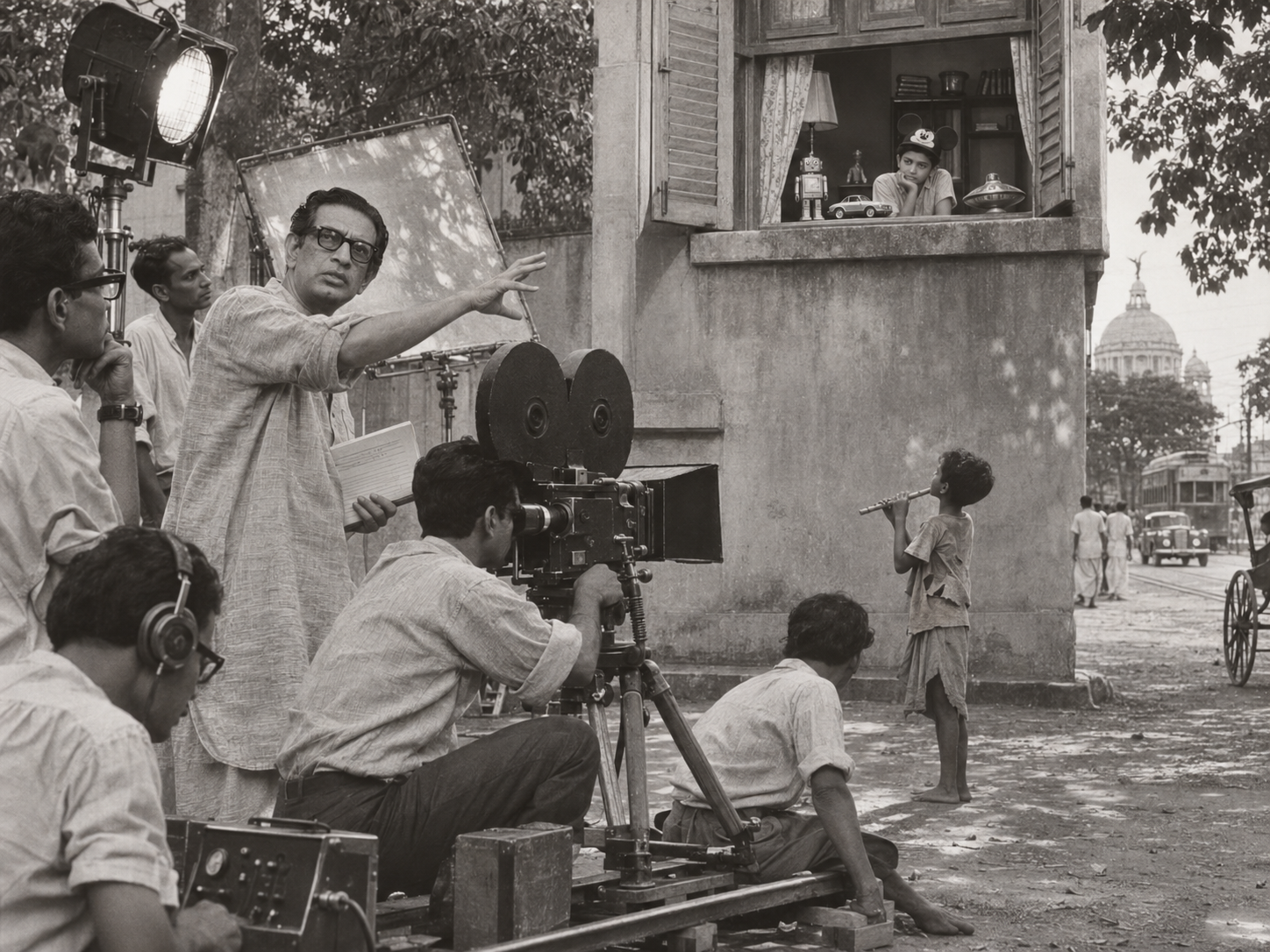
In twelve wordless minutes, Satyajit Ray turned two boys, one window, a kite and a toy gun into a portrait of inequality that still feels painfully current. Sixty years later, India is still watching from upstairs.
Satyajit Ray’s 'Two' is a silent duel between privilege and powerlessness: one boy armed with toys, the other with a flute and a kite. This essay revisits the film through today’s India — extravagant weddings, student protests, violence, inequality and the strange ease with which suffering and spectacle now occupy the same screen — to ask whether we have become too comfortable looking down without ever coming downstairs.
Picture a film of a kite flying and holes shooting off its every strand of hope. Now take out every word.
The auburn smell of marigold still afresh on our hearts and the sorrow of the goddess departing us another year. There hasn't been a more fitting time than now to give the legend a rewatch. The sun is setting early, the familiar scent of pollution clouds the Delhi air, and Satyajit Ray's Two is sitting on YouTube, twelve minutes long, free of charge, and somehow still the most expensive thing anyone has ever said about this country.
**A Flute, a Rifle and a Mickey Mouse Cap**
In 1964, American television asked Ray for a short film in English. Ray, who evidently had better things to do with English, handed in a film with no dialogue at all and composed the score himself. A rich boy sits in a flat stuffed with foreign toys, bored out of his tiny skull, Coca-Cola within reach, Mickey Mouse on his head. Down below his window, in the slum, a poor boy plays a flute. That's it. That's the whole war.
What follows is the politest escalation in cinema, mostly because nobody gets to say a word. The flute is drowned by a toy trumpet. A homemade mask and spear are answered by a cowboy outfit and a gun. And when the poor boy finally sends up a kite, the kind of thing that costs nothing and still goes all the way to the sky, the rich boy picks up his toy rifle and shoots it down. The poor boy, having tried every route to friendship through that one window, gives up. The rich boy is rather pleased with himself. Then, faintly, the flute again, and the loudest, shiniest thing in the house, his mechanical robot, trips and breaks down. The film ends on a child sitting with a defeat he can't say out loud. Some read it as the Vietnam War in miniature, the superpower with the gadgets versus the village with the flute. Ray, you suspect, would have shrugged and said it works for any building with a slum underneath it.
**Plus One, Plus Palace** Nothing says Two quite like a wedding invitation that says "and plus one." Somewhere this season, a palace is hosting the kind of wedding that has its own hashtag, its own choreographer and its own recovery lounge for the morning after. A pop star flown in because the cousins wanted "something international." A cake you need scaffolding to cut. A guest list that reads like a Forbes list with better snacks, and a dress code PDF longer than most syllabi. Wedding season, conveniently, is around the corner again, and by one trade body's estimate a single November-December window has seen 32 lakh weddings and nearly ₹3.75 lakh crore change hands. That is a lot of plus-ones.
Ray's rich boy had a Coke and a Mickey Mouse cap. His grandchildren have a pastry the height of a first-floor balcony. He never grew up, he just got a bigger window and a better sound system.
The cruelest design choice in the film is geography. The rich boy lives up, the poor boy lives down, and we watch the whole thing from upstairs. Today that window is a phone. Scroll once and the sangeet reel, all sequins and slow-motion confetti, is followed by a video of tear gas in Ranchi, followed by someone's skincare routine. Same thumb, same three seconds, same swipe. We've perfected the rich boy's finest skill: looking down without leaning out.
**Sangeet and Sangharsh**
Meanwhile, down in the grass, the other India doesn't do sangeet. It does sangharsh.
In May, lakhs of NEET aspirants, who had spent years of their only life in coaching-centre cubicles on a diet of Maggi, mock tests and parental prayer, were told the paper had leaked and the exam stood cancelled. They did what a person without a toy rifle can do, which is show up. Water cannons in Thiruvananthapuram. A hundred and eighty detained in a single day in Chennai. It's a peculiar country where you can be bundled into a van for asking that an exam be fair.
On August 4, a sixteen-year-old was gang-raped inside a moving private sleeper bus in Delhi-NCR, and the candles came out again, from the same drawer we put them in after the last time. We are a nation with superb candle logistics and a very short memory.
In Jharkhand, job aspirants marched over alleged irregularities in a civil services exam and met lathis and tear gas; a former chairman of the state public service commission was eventually arrested in connection with it. In January, tribal communities shut the state down after the killing of Soma Munda, a leader who headed twenty-two villages. And last year in Nagri, a protest against land acquisition was named, with devastating innocence, "plough the field, plant the sapling," a sentence that should never need a police permit. FIRs followed anyway.
During the Jharkhand protest, a video floated across the internet, of a boy walking us through the contrasting image of two Jharkhands. Where one orders a bucket full of edibles whose worth exceeds the average expense per day of another. If we look closely, this penetrates the truth of our society in every corner where people are divided on dualities of have and have nots (a tale as old as time and one wise german). And fate has it, that history didn't repeat as tragedy, it was replete with it throughout.
Ray worked it out in twelve minutes, in 1964, without a single subtitle.
**The Flute Doesn't Fold**
Here's what Ray did that sounds small and isn't: he never gave the poor boy a bigger toy. Every escalation belongs to the boy upstairs. The other boy's whole arsenal is a flute, a mask, a kite, things you can make from whatever is lying about, plus the one thing nobody can confiscate, which is music. Shoot down the kite and the flute remains. Squint a little and that's every protest this country has ever staged: aspirants outside the testing agency, women walking with candles at midnight, farmers ploughing their own land and being booked for it. Each one a small boy, a humble instrument and a stubborn refusal to go indoors. It's a good week to remember that our oldest story ends the same way. The demon with the largest army and the finest boons, undone anyway; the goddess, once the work is done, sent home with sweets and sorrow. She has gone for the year. The rest of us are left with the window, the view, and the question Ray leaves on a child's face as the robot stumbles: what do you do when your loudest toy breaks?
Put the rifle down, maybe. Open the window wider. Come down the stairs. And listen, because somewhere under all that marigold and marble, a flute is warming up.
Latest stories
- Two Boys, One Window, Zero Dialogue
- EU Film Festival Delhi: 28 films at six venues from November 25
- IIT Bombay launches KrishiDrought portal with four-week drought forecasts
- Bengaluru’s Gubbi remakes Dr Rajkumar’s ‘If You Come Today’
- Beatlemania brings Beatles hits to Bengaluru on November 12
- Delhi AQI reaches 312, enters very poor category on Monday
- TAG Heuer unveils 250-piece Carrera India Edition in New Delhi
- Bengaluru: KPTCL plans digital platform for Karnataka power transactions
- Delhi, Noida events on November 2: concerts, comedy and workshop
- Jatin Kumar Nayak takes charge as IREDA chairman and managing director in New Delhi
- Greater Noida: Buddh circuit to host racing round on November 28-29
- Delhi and Gurgaon log their cleanest October air in years
- Sushant Lok 2 and 3 residents flag missing streetlights and damaged poles
- Molakalmuru saree recreated for NGMA Bengaluru exhibition
- 250 volunteers tend parks and lake-edge saplings across Bengaluru for Rajyotsava
- Bellandur apartment hosts Karnataka folk artists for Rajyotsava
- Delhi Airport trials Digi Yatra for international e-passport flyers
- Young India Marathon draws runners to Thane’s Hiranandani Meadows
- Thane permits only green crackers for Diwali, bars use after 10pm
- More than 800 school chess players set for Dahisar championship
Cities
- Delhi news
- Gurgaon news
- Noida news
- Greater Noida news
- Ghaziabad news
- Faridabad news
- Delhi NCR news
- Bengaluru news
- Mumbai news
- Navi Mumbai news
- Thane news
Sections
- Top Stories
- Latest
- Politics
- Governance
- Civic Issues
- Transport and Traffic
- Metro
- Roads and Infrastructure
- Weather and Air Quality
- Business and Startups
- Real Estate
- Education
- Health
- Environment
- Courts and Policy
- Safety
- Arts and Culture
- Events
- Things To Do
- Food and Drink
- New Openings
- Shopping
- Nightlife
- Neighbourhoods
- People
- Technology
- Sports
GTK covers the news, people, culture, neighbourhoods, civic life and food shaping India’s cities. Better Starts With Us.