The Writing on the Wall and Small Defiances in Bengaluru
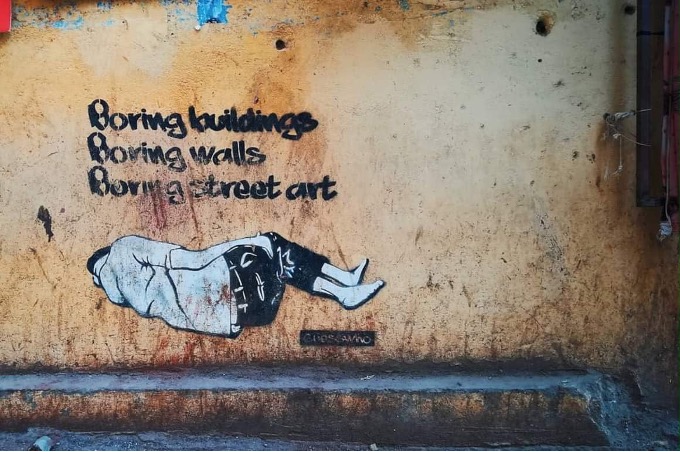
Bengaluru's walls as its report card, and how people write themselves into spaces they do not necessarily govern
From “Go Vegan” messages scribbled across signboards to names carved into school desks and street art that later enters galleries, this essay explores why people write on spaces they do not technically own. Through conversations with Bengaluru residents, it examines the uneasy line between expression and defacement, and what graffiti reveals about memory, legitimacy, belonging and the human desire to leave a trace behind.
**First Act of Defiance**
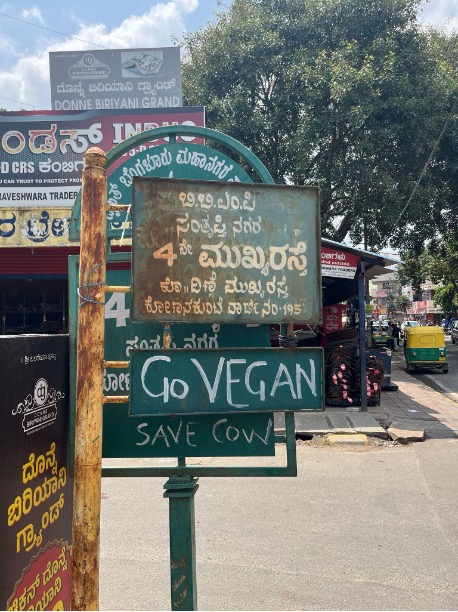
In Chemistry class, the good kid with straight A’s (and one D for math) who is praised at every parent-teacher meet and whose report card consistently reports, “she is one of our best students,” leans over the desk, fetches a compass from her pencil box, and, inscribes her initials S.T.R. on the desk. She adds an A for more impact and turns it into S.T.A.R. A STAR is what she is. Years later, on her way to work, she notices, “Go Vegan, Save Cow” scribbled in chalk, not over a desk, but over the city’s public walls, dividers, street signs, under overhead bridges, on advertisement boards and anywhere the city will take it. Someone cares about something, she thinks.
**The Writing on the Wall**
Bengaluru’s walls are like its report card. They are not merely boundaries that protect and define space within the city, but also a canvas for public expression. These walls record advertisements, posters, death notices, political messages, and graffiti, both sanctioned and unsanctioned. They report on the city, its people, and their experiences. They reveal the people’s values, interests, conflicts, desires, grief, and what people care about enough to put up on a wall to express publicly. Yet, what remains on a wall, what gets erased, and what never makes its way onto one, has more to it than what meets the eye. Though meeting the eye is the point of everything that does make it onto these walls. So if the intention is to command public gaze, it only makes sense to ask: what does inscription by the residents of Bengaluru on its public spaces, like walls, reveal about the manner in which the public positions itself in space and makes claims on its surroundings?
**Writing Against the Grain**
Aesthetic graffiti inspires a sense of wonder among many residents of Bengaluru and is often understood as ‘art’. Residents describe seeing the most iconic graffiti in Church Street, MG Road, and St. Mark’s Road. Perhaps this sense of wonder is particularly strong because graffiti inscribes against the grain - on public spaces - rather than within spaces designated for inscribing and displaying, such as art galleries. Graffiti proclaims, rather than displays. It commands attention, rather than seeking it. Graffiti, by nature, resists convention, and it is this very rule-breaking that makes it simultaneously appealing and accessible. Unofficial or unsanctioned graffiti that is not authorized, permitted, or commissioned takes the spirit of rebellion a step further. This is an inscription nobody asked for or expected; yet, it appears, and elicits a response, sometimes even inviting legal action. This inscription may include wall writing, doodling, scribbling, inscriptions of names, slogans, marks, symbols, or even what is conventionally understood as ‘art’. Through its presence, such inscription contests and subverts commonly understood notions of the right to space and the right to make meaning within it. It achieves this by intruding onto a space whose rules of design are governed by someone else.
**Who Cares? and Who Does Care**
For more than a year now, I have come across the ‘go vegan’ graffiti scribbled across Bengaluru. During the six months I passed it regularly, braving the dust and traffic and often thought of photographing it. I remember trying to do so, but the signal turned green, and my phone was in my bag, so I didn’t bother. On my way back in the evenings, I would sometimes see the rain washing it away. But next morning, the writing would inevitably reappear, as if to say, I was here. I am still here. I would notice it and wonder who would go through the trouble, and why? Eventually, this question led me to explore closely, not just the ‘go vegan’ graffiti, but also the different forms of unofficial graffiti across the city. I began by speaking to a few people who had encountered the ‘go vegan’ graffiti. They reported seeing the graffiti all over the city, including Indiranagar, Bannerghatta, Ulsoor, Marathalli, JP Nagar, and Kothnur. Rima Mukherjee, a resident of Bengaluru, described it as “Very matter of fact - not intrusive, just chalk and a basic legible handwriting.” She went on to say, “I’d rather look at this compared to the hundreds of posters wishing leaders happy birthday or for festivals that are an eyesore.” Another resident Naman Jain, shared photos he had clicked of the graffiti and told me, “I have seen a lot of graffiti during my time in Bengaluru, but the ‘go vegan’ graffiti has stayed with me the most. Perhaps because I’ve seen it repeatedly around metro stations, on ‘no-parking’ signboards, pillars and along sidewalks. I find it quite interesting and see it as a form of expression, though I am concerned it may result in damage or alteration of public property.”
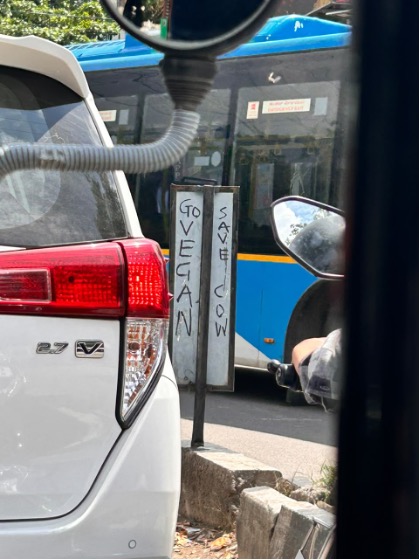
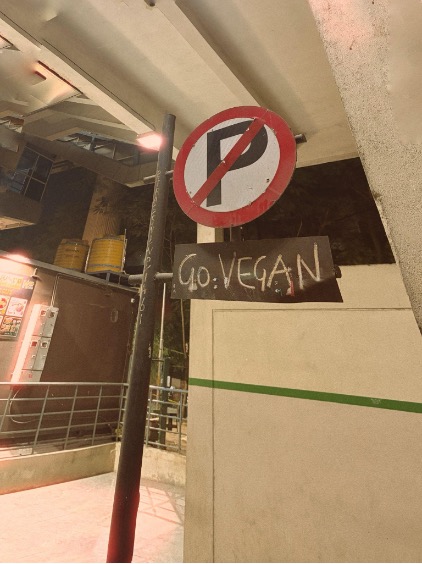
The graffiti drew the attention of Reddit users too. People posted pictures and discussed the graffiti in different forums. Many were curious about how it spread across the city, which further prompted curiosity about whether this was an individual’s work or a community campaign. The graffiti also sparked a debate between vandalism and activism. Many were annoyed by how the graffiti appeared on public surfaces across the city, while others considered it to be harmless. Many responded with jokes and sarcasm, with some users pledging to deliberately eat meat only to contradict the message. One of the users commented, “just add a don’t and move on.” Yet others defended the message and argued that animal welfare and the environmental impact of food were legitimate issues.
**Demanding Visibility**
The go-vegan graffiti got me thinking - what do residents of the city write towards, unofficially? And why do they do so? On my walks, I couldn’t help but notice public surfaces, walls, dividers, and signboards searching for some kind of inscription. The marks, signs, and messages eventually appeared.
I saw names on walls; perhaps a way of inscribing identity, marking territory, or both, as if to say, I was here once and in a way, I still am.
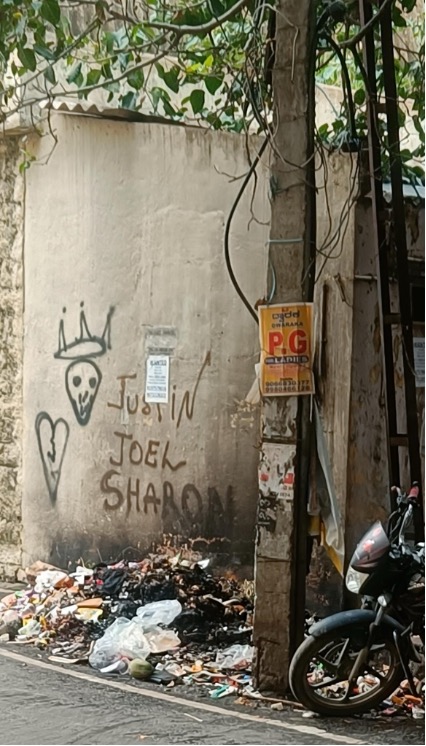
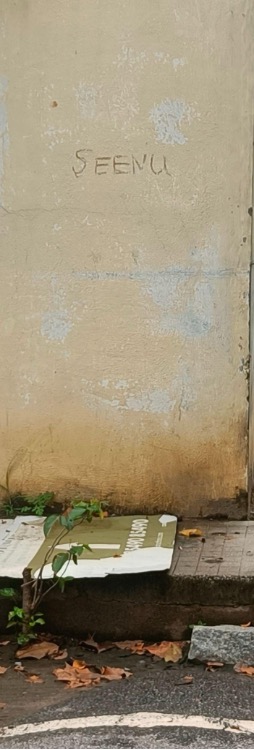
I spoke to more people about their views on graffiti more broadly, and whether they had ever written or sketched in a space that did not belong to them. Sithara, a resident of Bengaluru, described graffiti as “a cool way to express creativity and make a space unique. I think there are spaces where graffiti can merge with culture, but also spaces where people must refrain from doing so. I think official graffiti on spaces like metro pillars gives character to the city.” To the second part of the question, she responded, “I have doodled hearts and stars on school benches. I did it because there were already a lot of similar doodles on those benches from many generations of students. I find the concept of many lives being present in that small space really fascinating. I wanted to leave behind a small piece of my life too. It made me feel nostalgic even if I was present at that moment.” Her experience suggested that inscribing in space could also be a way of participating in something already shared and familiar.
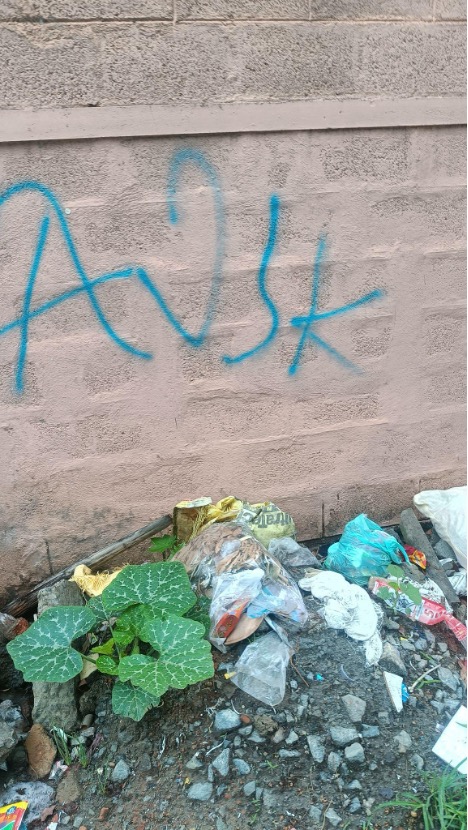
On my walks, I also saw markings that seemed to have no meaning, well, at least not to me.
I came across a public declaration of a private love that also revealed traces of its attempted erasure.
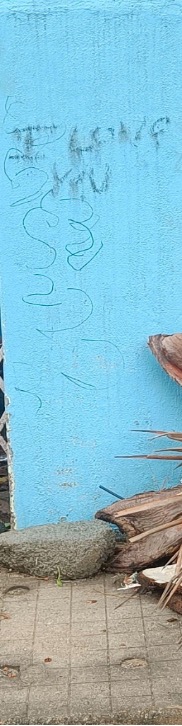
But should it have been written at all? What happens when a private feeling is made public in a manner that invites strangers to judge, interpret, and even participate in it? And who can say whether it was a declaration of love at all? What appears to be an expression of affection to a passer-by might have been quite different: an unwanted advance, a private joke, or a child’s split-second impulse.
Most of the walls and the surroundings bearing such graffiti or inscription bore marks of neglect. It was almost as if the graffiti was afraid to stand out even as it dared to. Perhaps this is why the ‘go vegan’ graffiti initially felt more annoying than intriguing. It was unashamedly and unapologetically everywhere. Yet, I realized that in contrast to the alleged declaration of love, the seemingly imposing ‘go vegan’ messages were, in reality, polite enough to be scribbled in chalk, at least most of the time. They would be easily erased in a single Bengaluru rain.
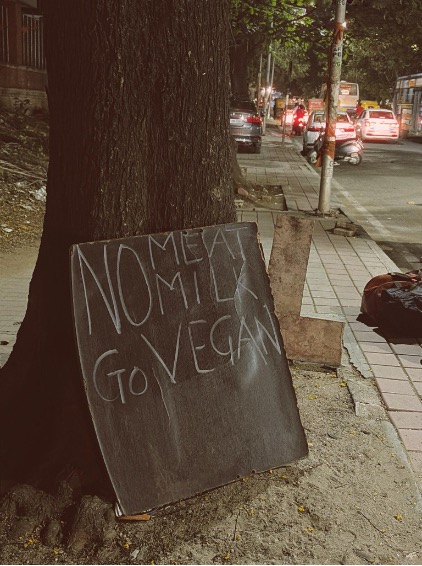
On another encounter with inscription, I came across a message whose authority was difficult to place, but whose purpose was clear. It marked out what was permitted and what wasn’t. The best thing? People listened.
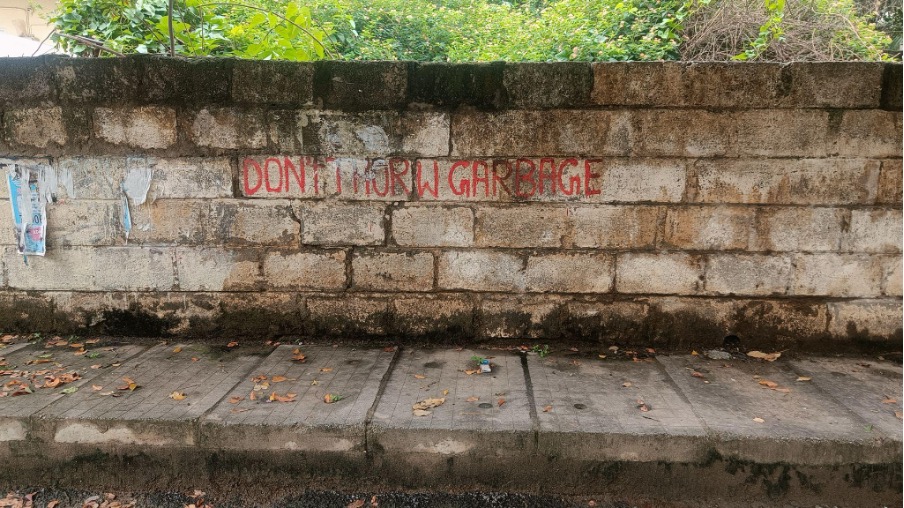
**Legitimacy, Illegitimacy, But Mostly the In-Between**
The artistic boundary may not always be the same as the legal boundary. In Bengaluru, unofficial graffiti and wall writing may be regulated through a few overlapping legal provisions. Section 92 of the Karnataka Police Act, 1963 addresses writing on, defacing, marking, sticking bills or notices on any government and public authority property. The Karnataka Open Places (Prevention of Disfigurement) Act 1981 provides a legal framework concerning unauthorised disfigurement by advertisement in spaces open to public view. However, its provisions have also been applied to graffiti in the past. In 2022, the word “SORRY” was painted in bold red over a hundred times on the walls and stairs of a private college in Bengaluru West. Police registered a case under the Karnataka Open Places (Prevention of Disfigurement) Act, despite the writing being graffiti rather than a conventional advertisement. News reports referred to the persons responsible as ‘artists’ even though there was no indication that the graffiti was meant to be an artistic expression. The act itself, though, was legally treated as disfigurement. This case illustrates how graffiti can be drawn into a legal framework designed mainly to address advertisements, blurring the boundary between public expression and defacement. For unofficial graffiti, other laws and legal provisions may also apply, depending on the circumstances.
Yet, the existing legal framework does not necessarily settle whether a piece of graffiti or writing is viewed by the residents as illegal, illegitimate, harmful, or merely a form of public expression. Sharing his observations about the ‘go vegan’ graffiti, Abhishek Bagalkot, a resident of Bengaluru said, “Using the empty space in a road sign board was an interesting choice of location for a call to action. But I did think that since this person is using government allotted boards, this may be a misuse of government property. But I was more amused by it than offended or inconvenienced by it.” Abhishek also raised concerns about potential defacement. “It's possible that messages could get upsetting if they are overtly critical. In that case, they would no longer be fun or harmless.” He explained that space mattered too. “I would not want graffiti on private property or on heritage buildings like Vidhana Soudha. That would be really wrong.” Distinguishing between graffiti as a form of expression and graffiti that crossed into defacement, Rima noted, “Graffiti is all about expression - as long as it's not defacing walls or putting content onto beautiful mural painted walls, it is just that - an expression.”
When it comes to unofficial or unsanctioned graffiti, legal status and cultural legitimacy may also differ. Though at some points, the two might converge The trajectory of the anonymous street artist Guesswho illustrates both divergence and convergence. In a 2014 interview, Guesswho described graffiti artists who ‘don’t wait for permission’ and referred to his work, ‘Kiss ‘em all’, as one such work that was subsequently whitewashed. Since then Guesswho’s art has made its way into art galleries. Guesswho’s first solo exhibition, STICK NO BILLS, is being held at the Muziris Contemporary’s Mumbai and Kochi galleries from August 23 - September 30.
**Residents Engage**
Residents have not treated Bengaluru’s graffiti and wall writing as something merely as objects of visual attention, but as forms of inscription that invite participation. Abhishek decided to click a picture of the ‘go vegan, save cow' graffiti and post it on his Instagram with the caption, “innovative ways of canvassing 🙂” Naman too, posted a picture of it on his Instagram. He said, “In the case of the ‘go vegan’ graffiti, I am particularly interested in how such a simple phrase could stand out in an otherwise ordinary public space.”
Another resident from Bengaluru who prefers to remain anonymous shared a picture of a graffiti by Guesswho that she captured on a wall in 2018, though it is not possible to say whether this piece was an official or unofficial inscription.
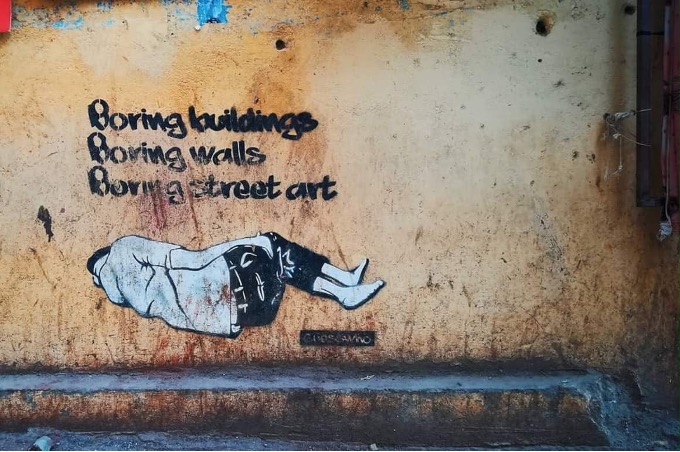
She also reminisced her poetic response to it:
“Undone pieces, Uncolored spaces, I’m going back in time, Tracing these carelessly scribbled lines, Hopefully, I’ll find you today, Following these clues you’ve left behind.”
Explaining her thoughts on graffiti, she said, “I think people tend to leave traces of their thoughts and experiences for other people who are able to relate to them, maybe offering comfort or motivation. This is what any art or writing does, and graffiti is the right mix of both - it makes one somewhere believe that oh, someone like me exists!” She further explained the unique ways in which she engaged with various kinds of graffiti. “When I first came to Bengaluru; and I’m bad at remembering directions and navigating maps, I used to remember places using graffiti.” For her, graffiti was not only something she could look at but also something she used to orient herself within Bengaluru.
**Meaning Making**
In Bengaluru, space is simultaneously institutionally governed and publicly encountered. Bengaluru’s unofficial graffiti reveals a tension between the formal governance of space and the manner in which that space is informally occupied and claimed by the people who encounter it. It is one of the ways in which people write themselves into spaces by having a presence within it. For many months, the ‘go vegan’ graffiti annoyed me. What is this silly compulsion? I wondered. Then I thought about the girl who inscribed her name on a desk that didn't belong to her, though in some way, it also did, and some part of me understood. And perhaps this essay was my way of engaging with the graffiti that I have come across.
Latest stories
- In-Conversation with Subir Malik – “We started Parikrama 35 years old as a bunch of young kids who love rock and roll and we are still those kids…”
- Humayunpur, Long Before the Hashtags
- Bengaluru logged 111.1 mm rain during Karnataka’s 2024 monsoon onset
- Fitour opens 14-seat, 18-course tasting menu in Bandra
- Mumbai to host Kia Tennis Premier League Season 8 auction on October 12
- At a Mumbai event, Vidyut Jammwal describes the discipline of Hollywood sets
- The Writing on the Wall and Small Defiances in Bengaluru
- India Mobile Congress 2026 opens in Dwarka on October 7
- Nine Days of Worship and a Never Ending War (against Patriarchy)
- At Ghalib’s Ballimaran haveli, a pink bucket shares space with poetry
- Andheri West: BMC sets December 2027 target for Kavathe Creek bridge
- Ireland education fair opens in Delhi with 17 universities
- Central Railway sets weekly, monthly checks at 17 Mumbai stations
- Delhi, Gurugram events on October 6: concert, films, jazz and comedy
- GMDA tenders Rs 7.2 crore service roads in Gurgaon’s Sectors 99 and 102
- MCG directs senior officers to inspect Gurgaon garbage hotspots daily
- Mumbai stations to review train announcements after one-minute gaps
- NMIA e-Shivai buses to Dadar, Borivali and Pune start October 7
- Flyadeal begins five weekly Mumbai–Riyadh flights
- Chandapura traffic delays stretch past two hours on Monday
Cities
- Delhi news
- Gurgaon news
- Noida news
- Greater Noida news
- Ghaziabad news
- Faridabad news
- Delhi NCR news
- Bengaluru news
- Mumbai news
- Navi Mumbai news
- Thane news
Sections
- Top Stories
- Latest
- Politics
- Governance
- Civic Issues
- Transport and Traffic
- Metro
- Roads and Infrastructure
- Weather and Air Quality
- Business and Startups
- Real Estate
- Education
- Health
- Environment
- Courts and Policy
- Safety
- Arts and Culture
- Events
- Things To Do
- Food and Drink
- New Openings
- Shopping
- Nightlife
- Neighbourhoods
- People
- Technology
- Sports
GTK covers the news, people, culture, neighbourhoods, civic life and food shaping India’s cities. Better Starts With Us.